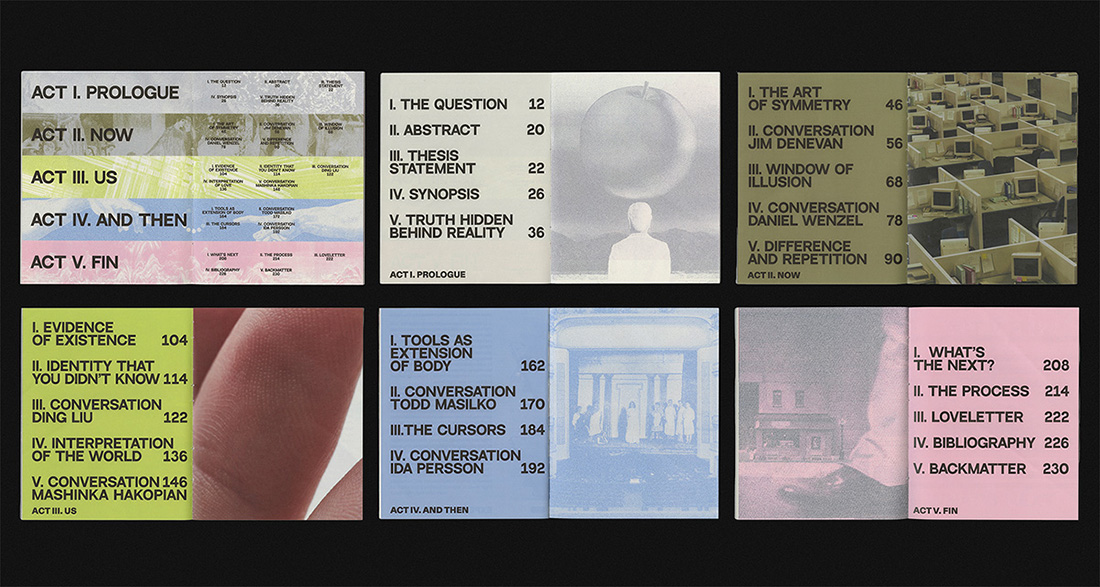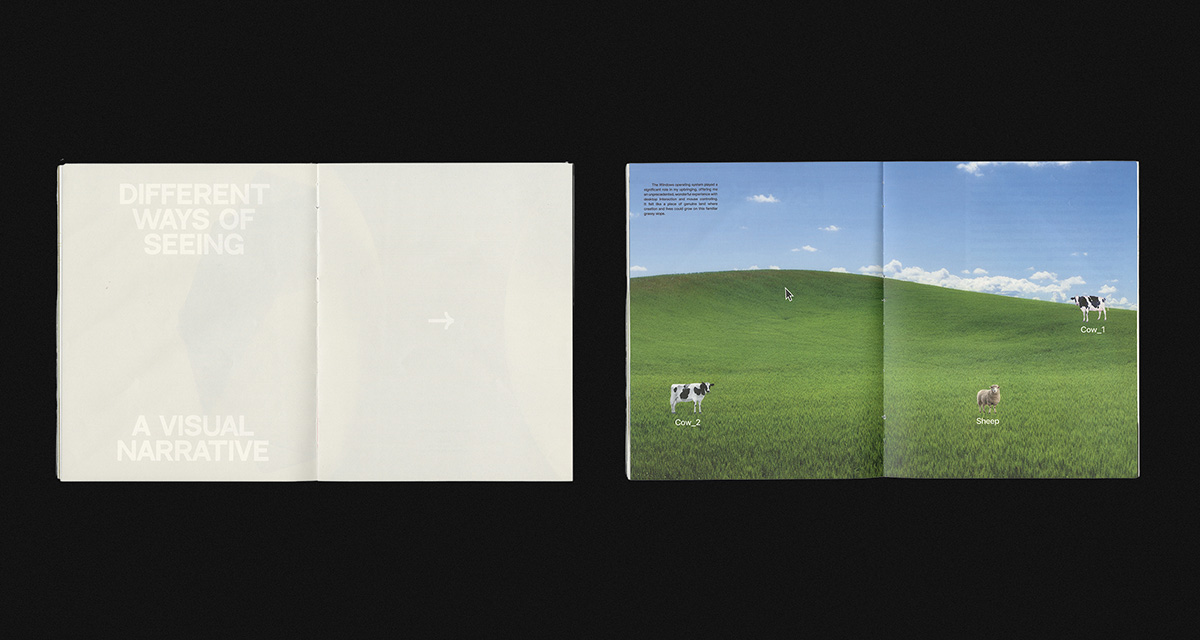
Different Ways of Seeing
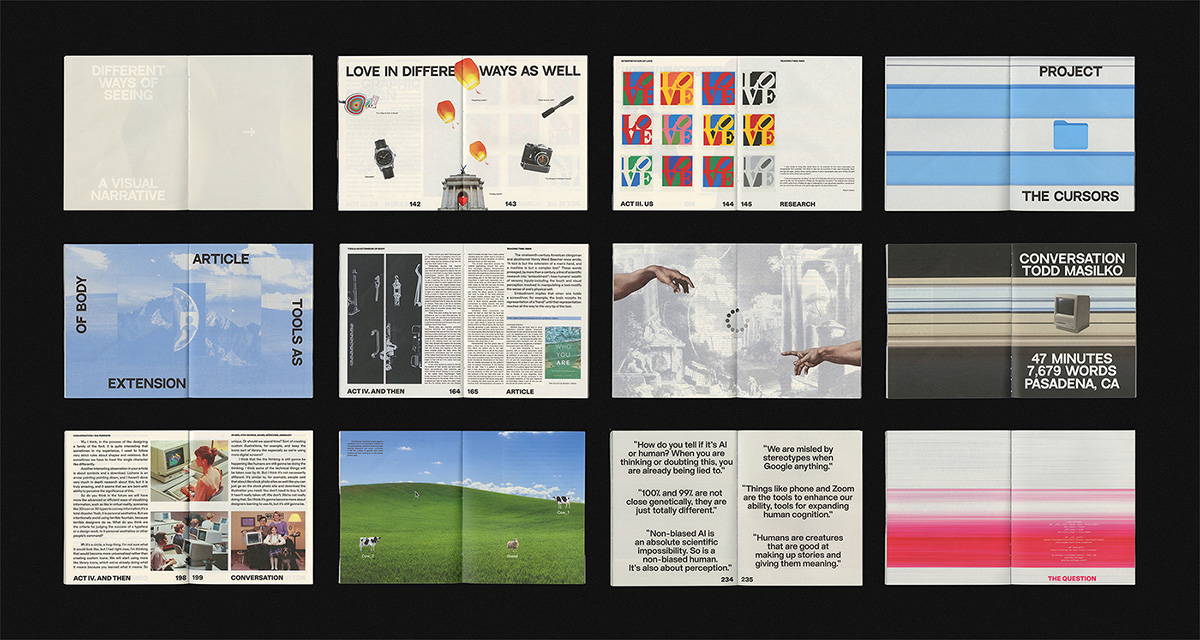
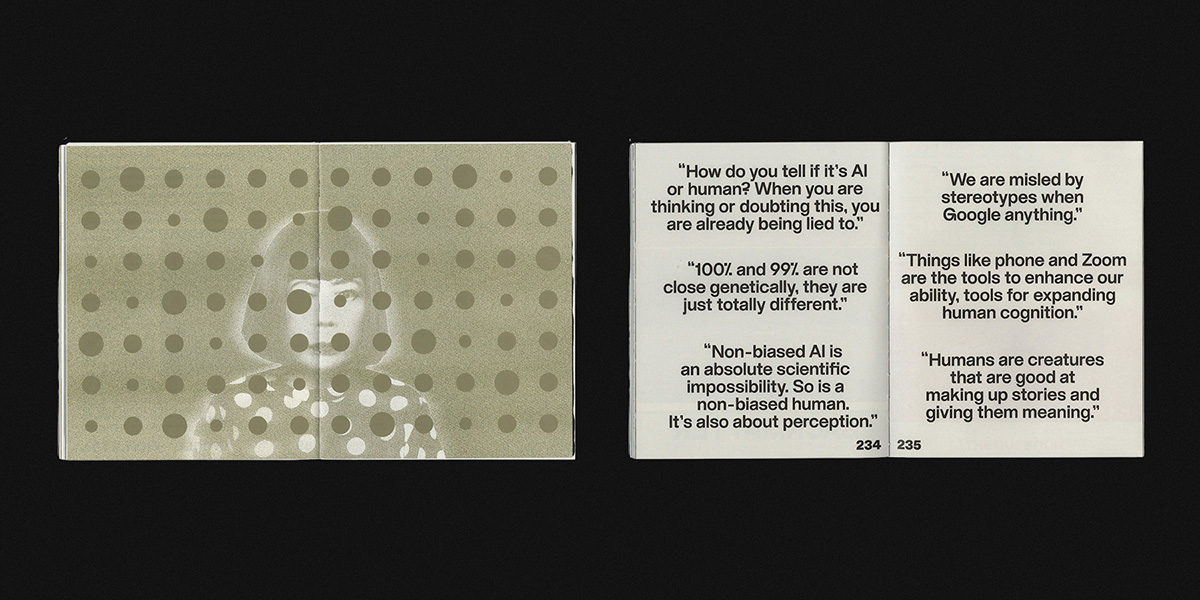
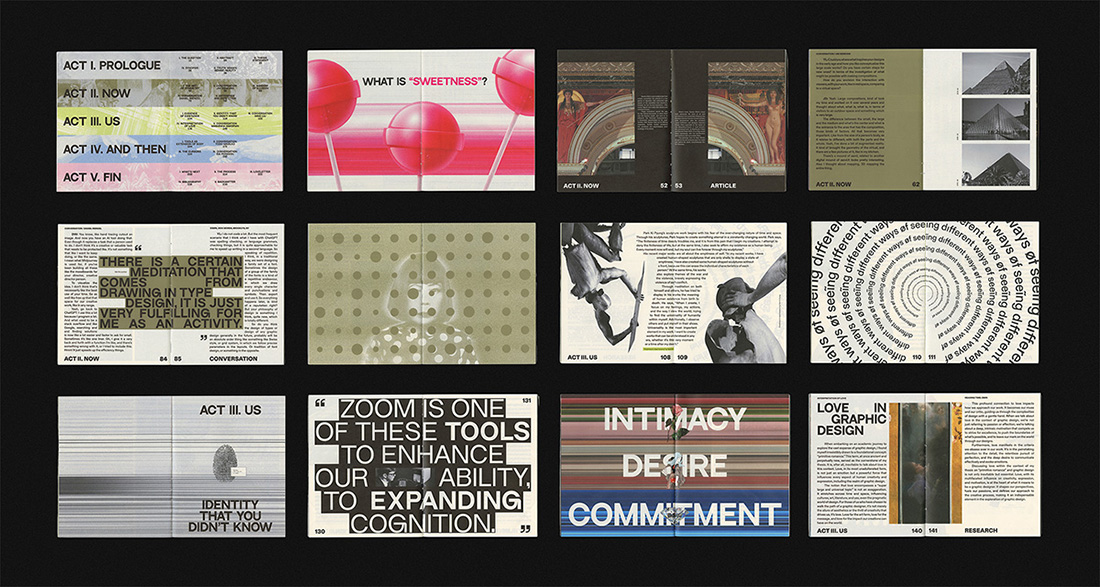
When I was a child, I once fell ill with a fever and felt as if the world was spinning. As I stared at the white ceiling of my bedroom, I was struck by peculiar questions: Why am I in a body looking like this? How is the world I see different from what others see? Then, I looked into some research and readings on neuroscience, and I came across many interesting findings: The visual information received by our brains actually undergoes a process of inversion, similar to how cameras work. We humans are creatures that are good at making up stories and giving them meaning. We love creating and listening to stories. Graphic design shapes human perception and biases through visual storytelling, acting as a form of visual poetry that can convey complex ideas and evoke emotional responses. This thesis demonstrates how the storytelling in graphic design can subtly alter the observer’s consciousness, steering emotions, beliefs, and actions. It aims to create immersive experiences that provoke discussion on the relationship between design and perception.
Different Ways of Seeing was born out of a simple question: What is sweetness? It’s so simple, yet completely indescribable. We’ve moved from our basic instincts to now creating virtual worlds, evolving from animal to AI. As our world becomes more and more immersive, bias occurs and perception becomes more subjective, moving our reality further from actual information in this unstoppable process. Design structures people’s perceptions and changes the way they communicate with each other. My ideas have been influenced by a podcast talking about the boundary of virtuality and reality by a postdoctoral researcher Ding Liu from Harvard. I realized how subjective we are as creatures in the way we perceive the world, and how interesting the biases occurred in the perception are to us as graphic designers. I will be composing a unique story, a journey in which I will share and interact with all the unexpected visual deviations of the experience for each viewer. We might be able to find a little bit of primitive romance through this journey. Humans used to acquire colors from nature at the beginning of our history, yet as technology has progressed, we’ve become less and less romantic.
One can take this a step further as Joshua Ramey shows us; that if reality is a simulacrum, then the “truth” of reality cannot be discovered by distinguishing the authentic from the inauthentic, the accidental from the essential, the artificial from the real. The authenticity of the real is discovered, in Deleuze’s view, in certain kinds of betrayal. True vitality is found only in certain obsessions, knowledge in a kind of intimacy with the obscure, the true nature of time in discontinuity, and genuine health only in extremes. If the “upright” Platonist proceeds out of the cave, out of the world of appearances, the overturned Platonist is a diver who plunges into the depths of the cave itself, into the uncanny world of difference and repetition. Against Platonic representation we get Deleuze.
In the midst of an illness marked by a high fever, I was transported back to a peculiar memory from my childhood, a memory that seemed to mirror the depth of my existential reflections during my fevered state. Confined to the small, dimly lit room of my present, staring into the vast whiteness of the ceiling, I was reminded of days spent beside a bustling road near my primary school campus. Back then, a close friend and I would stand as silent observers, our young minds fascinated by the stream of cars and pedestrians. We pondered the inner lives of those passing by, speculating about the myriad emotions, thoughts, and soulful experiences hidden within each person. This memory, a tableau of innocence and wonder, resonated deeply with my current state of vulnerability and introspection. As I lay there, feverish and adrift in thoughts, the sensation that my soul might at any moment detach from my body was terrifying yet eerily familiar. It echoed those childhood musings about the essence of existence within others. Now, faced with my own existential crisis, I grappled with profound questions: “Why do I exist as the person I am, bound to a body bearing my name? What is the essence of this ‘self’ I perceive, and what purpose does it serve in the grand tapestry of existence?” This blend of past and present reflections brought to the forefront a profound sense of connection with the wider human experience, yet also a deep-seated feeling of isolation as I confronted these unanswerable questions alone, hovering on the brink of an existential void.
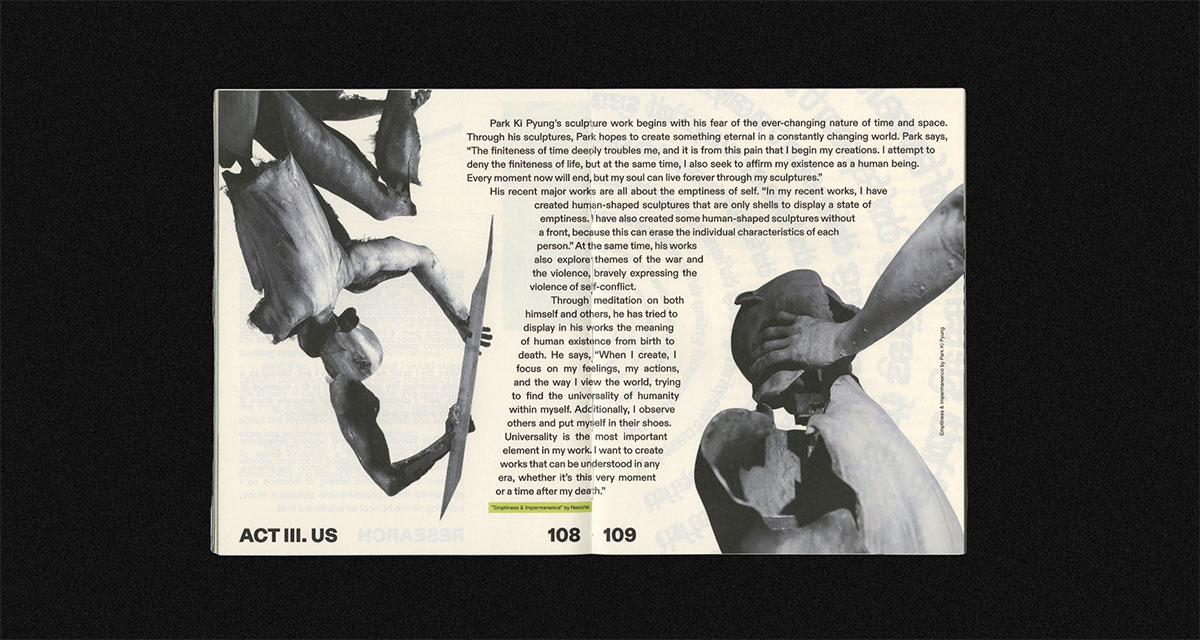
When embarking on an academic journey to explore the vast expanse of graphic design, I found myself irresistibly drawn to a foundational concept: “primitive romance.” This term, at once ancient and perpetually new, served as the cornerstone of my thesis. It is, after all, inevitable to talk about love in this context. Love, in its most unadulterated form, is not just an emotion but a powerful force that influences every aspect of human creativity and expression, including the realm of graphic design. The notion that love encompasses a “super large and universal topic” is not an exaggeration. It stretches across time and space, influencing cultures, art, literature, and yes, even the pragmatic world of design. For those of us who have chosen to walk the path of a graphic designer, it’s not merely the allure of aesthetics or the thrill of creativity that drives us; it’s love. Love for the art form, love for the message, and love for the impact our creations can have on the world. This profound connection to love impacts how we approach our work. It becomes our muse and our critic, guiding us through the complexities of design with a gentle hand. When we talk about love in the context of graphic design, we’re not just referring to passion or affection; we’re talking about a deep, intrinsic motivation that compels us to strive for excellence, to push the boundaries of what’s possible, and to leave our mark on the world through our designs.Furthermore, love manifests in the criteria we obsess over in our work. It’s in the painstaking attention to the detail, the relentless pursuit of perfection, and the deep desire to communicate effectively and evoke emotions. Discussing love within the context of my thesis on “primitive romance” and graphic design is not only inevitable but essential. Love, with its multifaceted influence on creativity, expression, and motivation, is at the heart of what it means to be a graphic designer. It shapes our perspectives, fuels our passions, and defines our approach to the creative process, making it an indispensable element in the exploration of graphic design.
The nineteenth-century American clergyman and abolitionist Henry Ward Beecher once wrote, “A tool is but the extension of a man’s hand, and a machine is but a complex tool.” These words presaged, by more than a century, a line of scientific research into “embodiment”: how humans’ wealth of sensory inputs-including the touch and visual perception involved in manipulating a tool-modify the sense of one’s physical self. Embodiment implies that when one holds a screwdriver, for example, the brain morphs its representation of a “hand” until that representation reaches all the way to the very tip of the tool. Whether they are tools, toys, or mirror reflections, external objects temporarily become part of who we are all the time. When I put my eyeglasses on, I am a being with 20/20 vision, not because my body can do that it can’t, but because my body-with-augmented-vision-hardware can. So that’s who I am when I wear my glasses: a hardware-enhanced human with 20/20 vision. If you have thousands of hours of practice with a musical instrument, when you play music with that object, it feels like an extension of your body, because it is. When you hold your smartphone in your hand, it’s not just the morphological computation happening at the surface of your skin that becomes part of who you are. As long as you have Wi-Fi or a phone signal, the information available all over the internet (both true and false information, real news and fabricated lies) is literally at your fingertips. Even when you’re not directly accessing it, the immediate availability of that vast maelstrom of information makes it part of who you are, lies and all. Be careful with that.
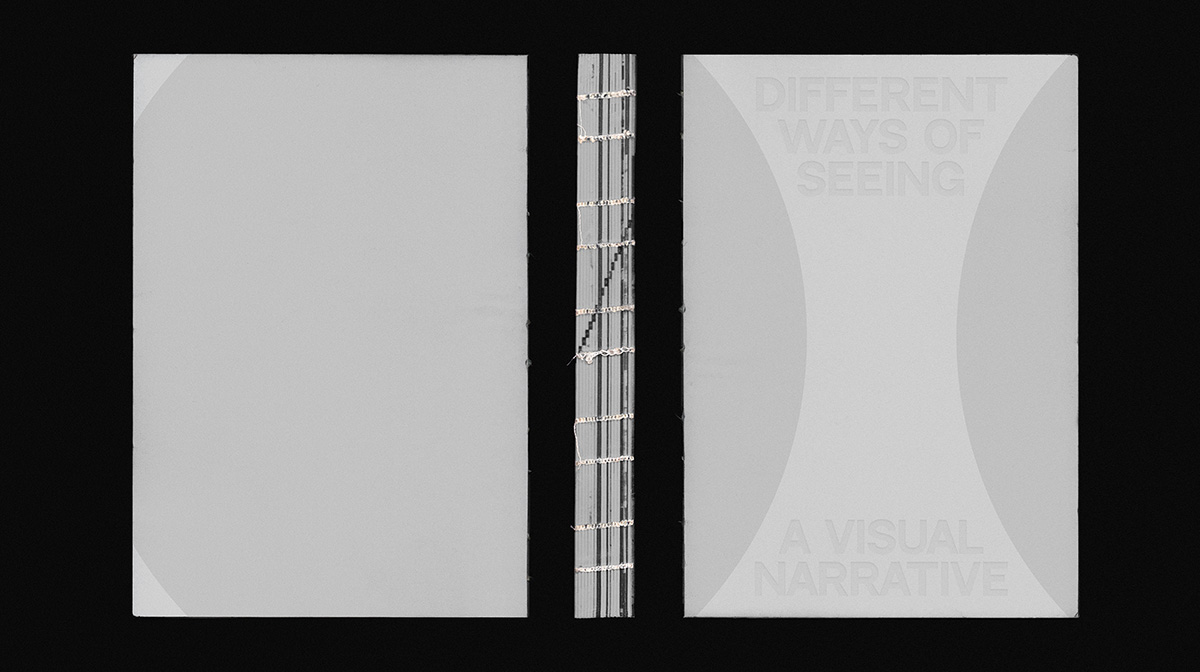
Graphic design shapes human perception and biases through visual storytelling, acting as a form of visual poetry that can convey complex ideas and evoke emotional responses, thus influencing cognitive and cultural shifts. This book demonstrates how the storytelling in graphic design can subtly alter the observer’s consciousness, steering emotions, beliefs, and actions. It aims to create immersive experiences that provoke discussion on the relationship between design and perception.
Find the project here.