Meet HfG Karlsruhe’s New Rector
Interview with Dr. Andreas Vogel
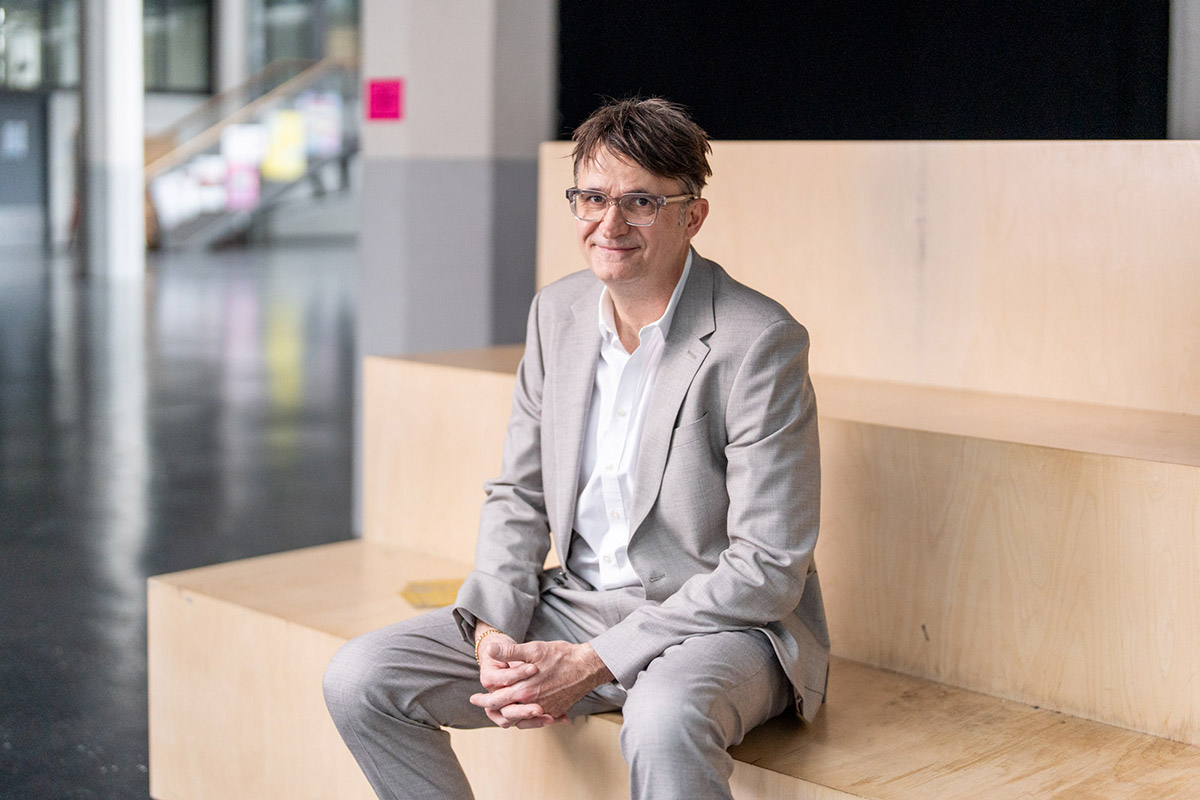
In April 2026, Dr. Andreas Vogel took office as rector of the Karlsruhe University of Arts and Design (HfG Karlsruhe), succeeding Jan Boelen. Trained in art history, German studies and urban planning, he spent 25 years in arts education in Switzerland, in increasingly senior roles: at the F+F School for Art and Media Design in Zurich, where he became managing rector in 2010, on the executive board of the Bern University of the Arts, and most recently at the Zurich University of the Arts (ZHdK). Alongside his academic work, he has been active as a curator and as an author on architecture, art in public space and contemporary art, and he co-runs the Archive of Swiss Independent Periodical Publishing (ASIPP). As a fellow Karlsruhe institution, Slanted has long valued HfG as a friend and neighbour, so a few months into his tenure we were glad to sit down with him to talk about the school's transdisciplinary DNA, its students, Karlsruhe's cultural scene and what AI means for the future of design.
Your academic training spans art history, German studies, and urban planning—a notably interdisciplinary foundation. How do these three fields still inform your thinking as rector, particularly in the context of HfG's transdisciplinary mission?
My studies were what first taught me critical thinking in any meaningful way. And then I realized early on that I was interested in social negotiation processes and the spaces in which they take place. That’s why, in art history, I focused on architecture and art in public spaces; in urban planning, on the utopias of urban design; and in German studies, on language as the primary tool for sharing my own thoughts and insights. Throughout this journey, I’ve always been guided by the conviction that these different perspectives enrich one another. In a sense, my own transdisciplinary approach was already taking shape—and that is precisely why the Karlsruhe University of Arts and Design aka “HfG Karlsruhe” (short for Hochschule für Gestaltung Karlsruhe), with its explicit emphasis on transdisciplinarity, resonates so deeply with me.
You've held leadership roles across multiple European institutions: F+F Zurich, Bern University of the Arts, and most recently ZHdK. What drew you specifically to HfG Karlsruhe, and what do you see as distinctly different about this institution?
At the HfG Karlsruhe, the spirit of reform that decisively shaped its founding in the early 1990s remains alive to this day in a form that is constantly being updated. The critical conviction that things can be done differently, that discomfort gives rise to productive friction, and that it is necessary to negotiate and endure unity in dissent—all of these are elements of the HfG’s DNA that appealed to me. At the F+F in Zurich, I had worked under an even freer—but also enormously unstable—umbrella. At the art universities in Bern and especially in Zurich, I then became convinced that universities with a clearly top-down structure interest me far less than a dynamic academic environment with strong academic self-governance and a constant willingness to renegotiate.
Your work beyond academia—as a curator, board member of the Berner Designstiftung, jury member at the Guggenheim Foundation—suggests you see the academy as embedded in broader cultural ecosystems. How do you envision that relationship at HfG Karlsruhe?
Yes, we are not alone here. Fortunately, the image of a university like ours as a “sheltered workshop” has become just as outdated as that of the laboratory with all its clichés. We are not only part of ecosystems; we are constantly shaped by them and, at the same time, change them. Accordingly, these relationships are not just about issues of mediation, support, and funding. It’s about actively helping to shape these systems and using networks not only for our own benefit, but in the interest of shared development. The institutions mentioned in the question were all part of a rather traditional system of cultural landscape and cultural funding. Today, the HfG Karlsruhe—and this brings us back to transdisciplinarity—is at a different point: it needs different partnerships, different forms of engagement, and different forms of collaboration.
You took office in April 2026—so you're now a few months into your tenure at HfG. What has surprised you most so far, or what have you discovered that you didn't anticipate before arriving?
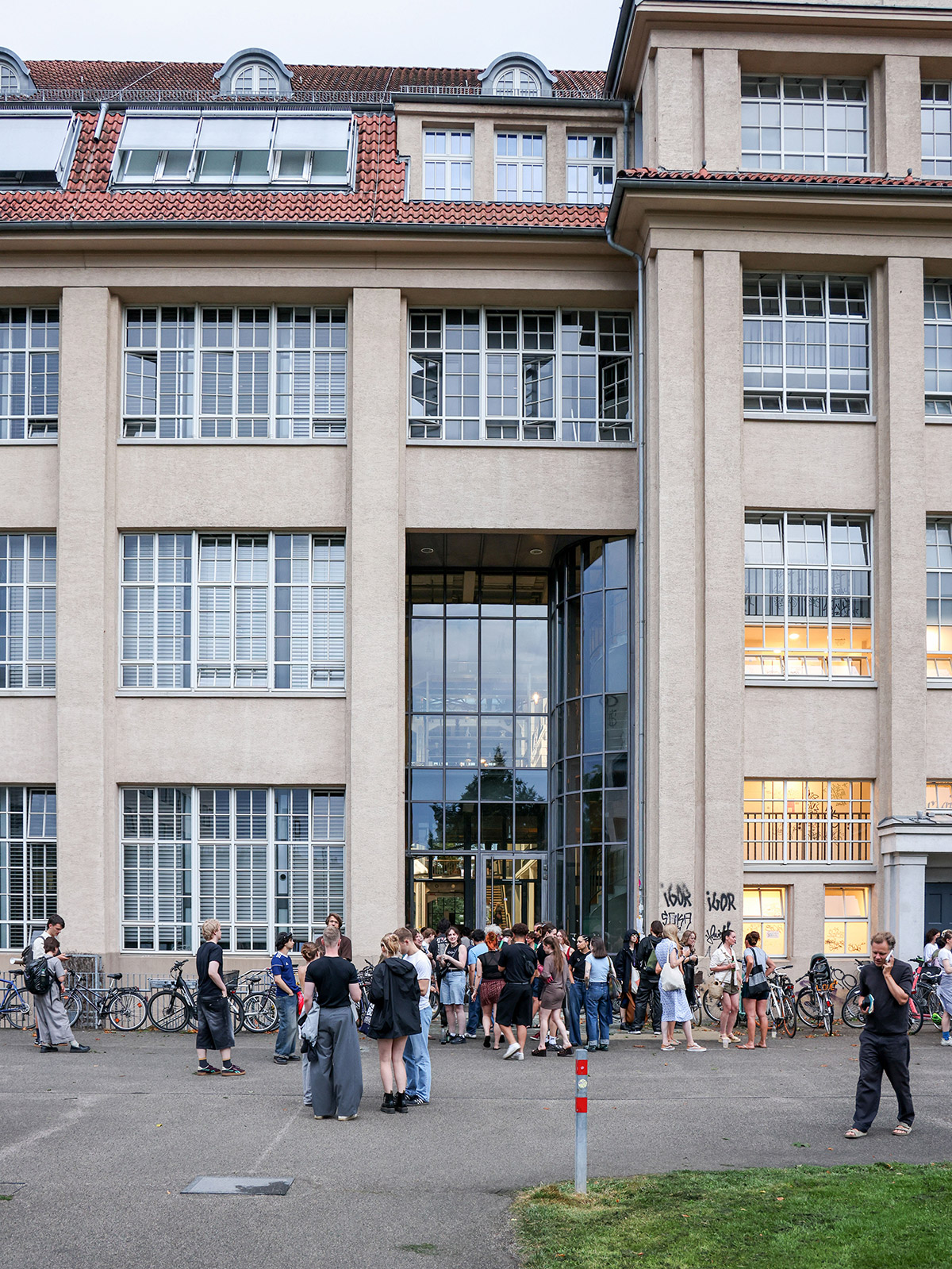
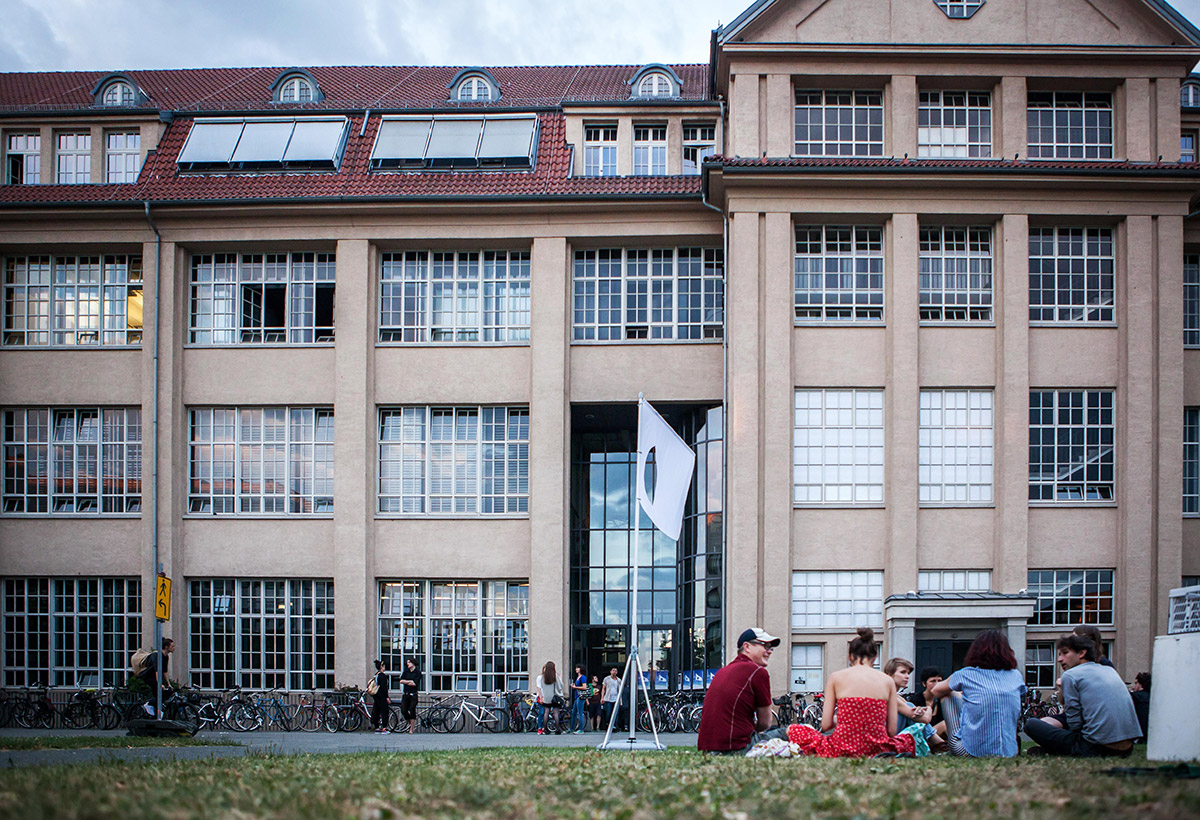
I never would have thought it possible that it could get so hot inside a building (especially one as exciting as the Hallenbau) …But all joking aside: While I had a pretty good idea of what to expect before taking office, I was pleasantly surprised by what a great place Karlsruhe is for the entire university community—by what’s possible here, what’s happening, and what’s taking shape. From my perspective, the opportunities for active participation here are enormous—and far more interesting than in many places that seem so much “cooler” at first glance but have already become finished and, as a result, hermetic copies of themselves.
In your statement, you spoke about remaining "open for new impulses" in challenging times. How do you understand these new impulses and the challenges you're referring to? What do you think matters most for institutions like HfG Karlsruhe– and for academia more broadly —in times like this?
Well, in the arts—including design and even in our theoretical disciplines—it was long possible to develop and address one’s own questions and problems largely on one’s own. Innovation and concrete solutions to socially relevant problems were traditionally expected more from other universities, not necessarily from art academies or design schools. We ourselves have played a major role in bringing about this change, in shifting this understanding: Our work is no longer perceived by society merely as a seismograph or a mirror held up to reality, but increasingly as an indispensable contribution to the concrete shaping and development of a thoroughly problematic world. Accordingly, we must now enter into different kinds of collaborations and work much more extensively in mixed, collaborative contexts. The design of processes has become just as important as the creation of works, products, and publications.
How have you experienced the students so far? Is there anything you’ve learned from them or seen differently through your interactions with them since joining HfG?
Above all, I am delighted by the diverse and high-caliber ways in which our students take advantage of the opportunities offered by their project-based—that is, non-module-driven—independent course of study. I regularly find myself both admiring and amazed by their work and projects, and in doing so, I am constantly rediscovering just how much is actually possible at the HfG Karlsruhe.
At the same time, I’m delighted to see how engaged, critical, and politically aware the students at the HfG are. I’m very pleased that most of them don’t just come here to study, but also bring their diverse life experiences with them. This brings the outside world and the institution into contact with one another—and the students play a significant role in shaping the university.
You've held leadership positions at three institutions. What is your leadership philosophy, and how does it differ from—or build upon—practices you've observed elsewhere?
I am a staunch advocate of transparent lateral leadership. I’m not interested in exercising or holding power.
Of course, that’s easier said than done when you’re nominally the boss—I’m well aware of that. However, I’m fortunate enough to be convinced that better results come from working together, that negotiation is fundamentally beneficial, and that agreement amid disagreement can be a perfectly normal state of affairs. I don’t have to decide everything on my own to ensure that, in the end, things turn out exactly as I envisioned. I can also advocate for a solution that I myself might not have chosen exactly that way, but which emerges as a consensus at the end of a multi-voiced process. A university like ours cannot be governed top-down. I therefore see my role as facilitating and coordinating, not dictating. But it’s also clear that there are moments when that isn’t possible. I’m working to ensure that those moments remain as rare as possible.
HfG Karlsruhe's identity is anchored in a specific synthesis of art, design, theory, and media. How do you plan to protect that unique profile while simultaneously remaining open to innovation?
Well, first of all, because I’m convinced that the academic structure established at the school’s founding is still the right one today. It’s hard to find another place where theory and practice are truly integrated on an equal footing. We have great opportunities to leverage this connection even more strongly—for example, in research projects—and in the future also through the hybrid PhD program we offer. After all, the individual elements of our HfG portfolio gain significance precisely because we relate them to one another and create shared spaces within an interdisciplinary or transdisciplinary setting. Moreover, with the Center for Art and Media (ZKM) in the same building, we have an outstanding sparring partner with whom we can continually revitalize our disciplinary and media fields. And fortunately, it is precisely these fields that are subject to constant questioning: What do we even mean by “media”? What is media art? Here, we cannot simply fall back on an existing canon. We must continually redefine for ourselves what these terms and fields actually mean. “Electronic, time-based, and using image pixels”—even at the time of the HfG’s founding, that was hardly sufficient as a definition. We are therefore both compelled and privileged to constantly renegotiate what we actually do here.
Karlsruhe has a distinctive cultural landscape, from its museums and institutions to its strong connections between art, technology, and design. Having now spent a few months here, what do you think makes Karlsruhe’s cultural scene special—and where do you see opportunities for HfG to play a stronger role within it?
As I mentioned earlier, Karlsruhe provides an excellent environment for trying things out, taking immediate action, networking, and collaborating. With its history as a hub of (digital) technology and its unique cultural infrastructure, Karlsruhe has also played a key role in our existence—and in our presence here. On top of that, there’s a genuine shared interest in the city’s development and cultural life that’s palpable in Karlsruhe. It’s fantastic to see how we, as the HfG, are perceived here. Many people aren’t just interested in us—they want to collaborate with us in very concrete ways. And I’m constantly amazed that a city where everyone somehow knows each other and knows exactly who’s doing what doesn’t necessarily feel small and confined—but, on the contrary, expands into a space of possibilities.
AI is fundamentally changing the way we design and how we understand creative work. How do you view this development—what role do you think design will play in the future, and how should a school like HfG respond to this change?
Well, AI is changing far more than that—potentially everything. And, of course, this development doesn’t stop at the HfG. We’re not a special case here. But places like our university have always been spaces where technological innovations are embraced, tested, put to use, and even critically reimagined.
What happens at the HfG is always content-driven. And we’ve always sought solutions using a wide variety of technological methods and tried to implement them. What drives us at our core is likely less influenced by AI than the way we do our work. What will certainly change, however, is how we arrive at results and how technological tools influence those results. This initially calls into question our established patterns of reception and evaluation. And it provides us with entirely new solutions. But even though I am convinced that we as a society have every reason to be very attentive and indeed concerned about AI—and must urgently create appropriate framework conditions—I am not anxious, especially with regard to the HfG.
What are your priorities for HfG's development over the next few years? Are there specific programs, structures, or relationships you want to establish or transform?
After just one short summer semester, I’m still new to the HfG Karlsruhe. And I’m still very much in observation mode. On top of that, as I mentioned above, certain questions at the HfG are constantly evolving and being reframed anyway. The questions I’m currently raising, for example, are about our opportunities for development in research and in the so-called third cycle—that is, at the PhD level—the further strengthening of our collaboration with the ZKM, and possible visions for the individual degree programs. But they also include the question of how we want to work together here to truly make the most of the HfG’s potential. In general, a certain form of cultural work is important to me. And in some places, it’s also necessary because we’ve apparently lost sight of one another in certain areas. It’s not just since the election results from Saxony-Anhalt that political questions have been arising with increasing frequency—questions of institutional responsibility as well as institutional legitimacy. This will continue to occupy us greatly in the coming years.
You've been instrumental in digitizing and preserving alternative publishing through the ASIPP archive. Do you foresee a similar archival or preservation mission within HfG, or are your priorities directed elsewhere?
Yes, the Archive of Swiss Independent Periodical Publishing (www.asipp.ch) is very close to my heart because the artifacts collected there reflect collaborative, critical practices that are both fascinating and socially significant. I found it incredibly rewarding to design and offer teaching and research programs centered on this topic.
But I certainly won’t simply copy this model here.
We do, however, lack an HfG archive. And I wouldn’t be an art historian if I didn’t deeply regret that. But we need such an archive not only to learn from our own history, but above all to give others a source-based opportunity to form their own picture of us. For at the same time, an often fleeting image of what a college of design can be is emerging here every day. My priority is to help ensure that this image is as diverse and interesting as possible.