What’s next in Seoul Design?
Essay by Chanwoolee
Coming back to Seoul marked the end of my first semester teaching in Korea. Designing designers was not an easy task. It’s a chaotic mixture of deciding which traits and values to prioritise and reinforce, considering each student’s growth and pathway, and ultimately asking how we equip a designer.
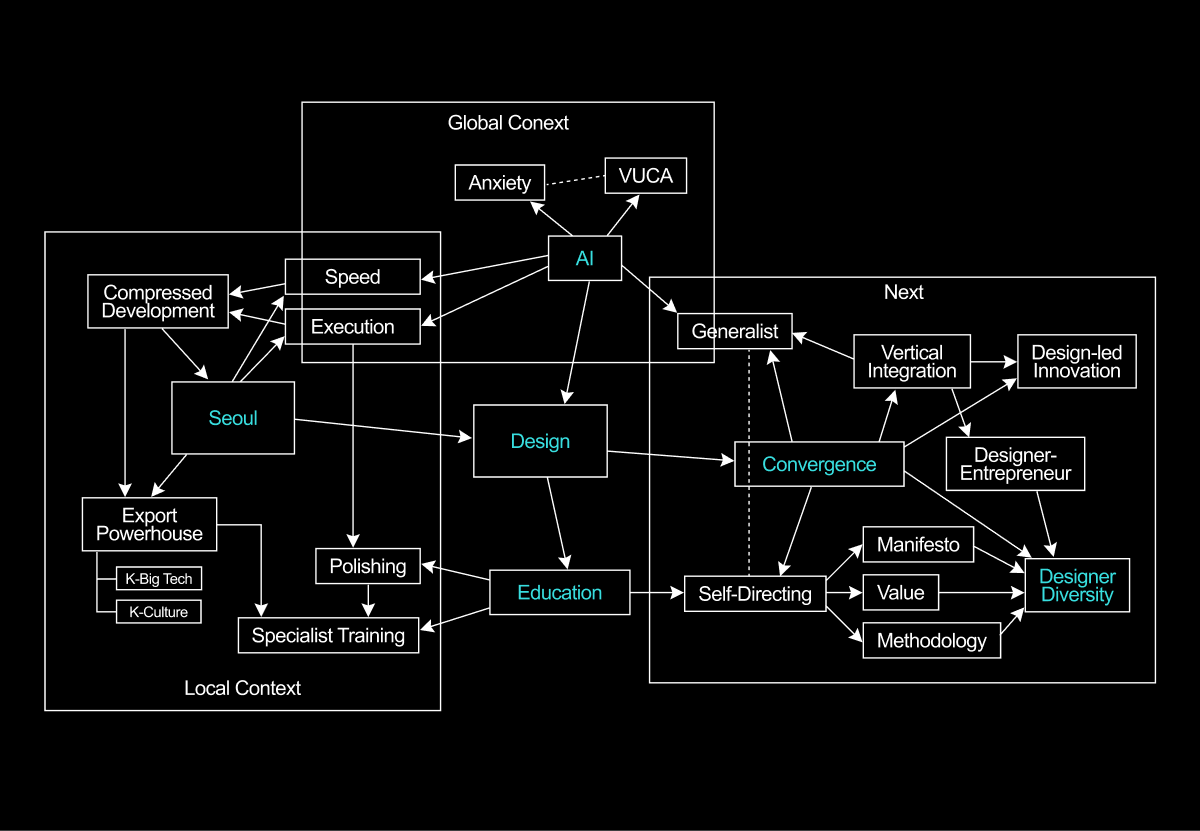
This is fundamentally a discussion of what Seoul’s contemporary design should be, as design is always tangled up with its context of culture, industry, and era. For Seoul design now, I see global forces such as the climate crisis, geopolitics, and AI interacting with local ones, chiefly hallyu and the rise of Korea’s soft power in culture and technology. What interests me is what happens where these forces meet. AI, in particular, seems to be hitting Seoul design in a very specific way because of its local context.
Born to Export
I didn’t go through what we call the art uni admissions process (“mi-dae-ipsi”). I was interested in design and active in the iOS jailbreak community, but studied the equivalent of AP Physics and Chemistry in high school, aiming for a CSE major. Choosing a transdisciplinary program called Art & Technology, it wasn’t the “authentic,” traditional design track in Korea. My friends and I always wondered what “authentic” design education even looked like.
Korea’s art school entrance exam system prepares students from a young age, teaching sketching, composition, and colour. Having come through a generalist education myself, I felt a bit outclassed by it. Now I don’t feel that way, as I see there’s no single answer to design education. But I can’t deny that this is a defining trait of Korean art schools. Plenty of senior educators here have told me their students are excellent at producing highly polished work. And it’s by design.
Korea developed in a uniquely compressed socio-cultural and industrial context, and I think that got written directly into our design. We went through colonization, war, dictatorship, and late industrialization in a few generations. Philosopher Tak Seok-san describes the Korean character partly through Life-ism, the pursuit of sensory pleasure, and Practicalism, an orientation toward what actually works.
I see Korean design in a similar condition. The Korea Institute of Design Promotion, originally founded as the Korea Design and Packaging Center, marks a moment when design was mobilized by the military dictatorship as an instrument of economic policy, built to serve the explicit national goal of becoming an “export powerhouse.” What Korean design developed was the ability to respond to what the era needed, which was speed and quality.
This leads to Korean design education prioritizing technique over inquiry, execution over concept. Design was handed a specific job from the beginning.
And it worked. Now Korea is an export economy anchored by semiconductors, Samsung, LG, and Hyundai, alongside fast-expanding cultural soft power in K-pop, gaming, and film. It shows up in manufacturing, and just as much in the graphic design and art direction behind Korean culture. Regardless of discipline, Korean design is having a moment. At the RCA, tutors keep asking me, half compliment, half genuine curiosity, how Korean designers are so good, and why there are suddenly so many of them. I am proud to see this momentum for Korean design to expand from that original specific job to something more.
What AI Changes for (Korean) Design
We’ve always been quick to adapt to new technology, and AI adoption is happening fast here. It has already hit the design classroom: students are actively using AI for research, concept development, visual making, prototyping, and even as a kind of emotional consultant.
Whenever someone said that their students are good at polishing, the thing they’d add right after was that some students struggle to find their own topic. When a ‘good project’ is too easily defined by portfolio value and employability, another kind of work can become lower priority. Work that is less visually resolved but asks a fundamental question has less room to survive. In that condition, design education risks becoming training for approval rather than training for judgement.
AI collapses many parts of the design process and it makes certain definitions of design insufficient. If AI can help produce a fast, highly finished output, the thing Korean design has historically been very good at, the qualities of a good designer, hard or soft, need to be redefined. Or at least, discussed.
I see technology as an external force acting on me. What’s truly important is where to go, and how to use that force, and it’s up to each designer. What we need is enough diversity to make room for those different directions. Korea has been an ecosystem of low diversity, and we might need more design diversity for a resilient ecosystem.
Innovation starts from alternative
We need species diversity.
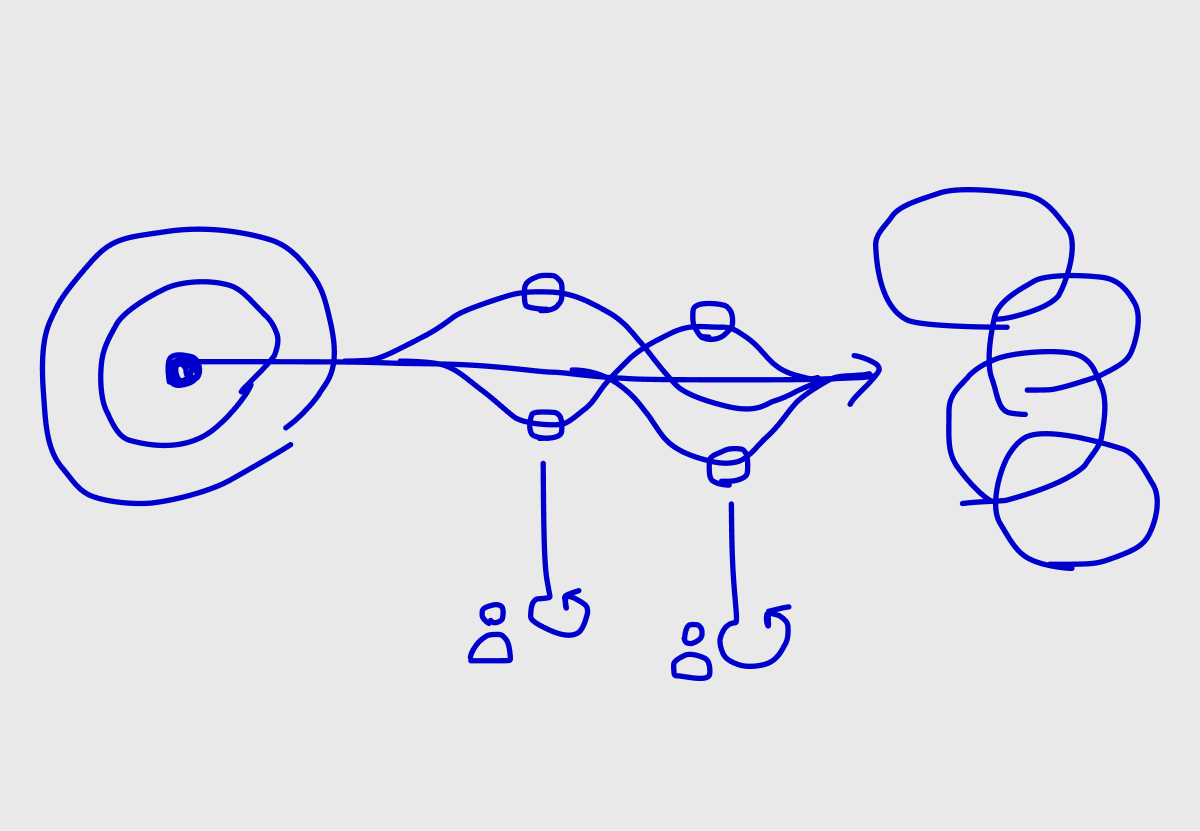
At Innovation Design Engineering, where I studied and teach, the first few weeks were the opposite experience I’d had in Korea. They didn’t let us fixate on ideas too early, they made us sit with them and let them develop. Rather than opening up the laptop, searching right away, or reaching for references, we talked, walked and made a lot of things out of cardboard.
This kind of micro-making, exploring, and hand stimulus connects to psychomotor learning. It helps us dodge the problem of tackling the wrong question. The whole world knows about ppalli-ppalli (빨리빨리, “hurry, hurry”), but there’s also a saying in Korea: the more you’re in a hurry, take the roundabout way.
When I helped to run workshops with Korean visiting students as teaching associate at RCA Executive Education, they weren’t comfortable closing their laptops and talking about values. But once you ask them to, they enjoy it and adapt fast, usually within a few days. It’s not that they can’t, they just didn’t know this kind of option existed. I see this as a hopeful sign.
It’s not that process is more important than outcome. The question is whether designers are given enough options to choose their own methodology and values within the environment they’re in. What we need is some room where alternatives can exist, and that would let the Seoul design ecosystem become richer.
Then, What could those alternatives actually be? I see the designer who starts from themselves as one of them. What remains distinctly human is a designer’s vision, values, history, and lived experience. No matter how well AI can write, it can’t write your diary for you. And as Norman Potter said, design as an act can’t be separated from the person doing it.
I think “design convergence” could be one of those alternatives. By this, I want to move past stacking skillsets from different disciplines for the sake of it. That kind of generalist has often been seen as someone without enough expertise within a conventional division of labour.
I see the generalist instead as a vertically integrated person. Someone with a clear view and goal of their own, who develops whatever capabilities are necessary to pursue it. Their expertise doesn’t sit neatly within a traditional discipline. It runs vertically through different disciplines, held together by a particular direction, value, or way of seeing the world. They are specialised on a different axis. They need a new playbook, and perhaps a new title.
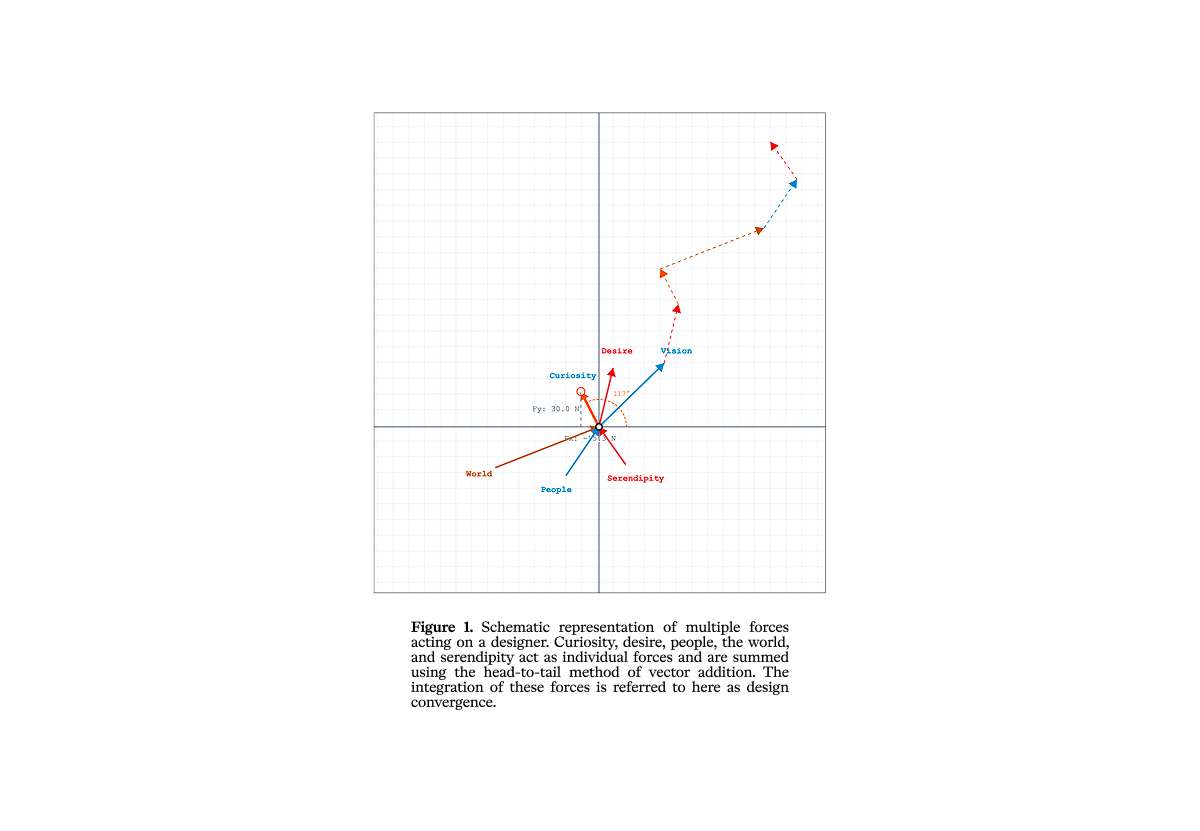
This is what I mean by design convergence: the convergence of different capabilities within a person, through design, towards a direction of their own. The point isn’t to know how to do everything. It’s to know what needs to be done, why, and to move across disciplines to make it happen. Maybe with the help of AI.
I ran this semester’s class this way, through process orientation, a designer’s ability to plan and choose their own methodology, manifesto, and ultimately vertical integration. There’s still a lot to figure out, including how to even evaluate this kind of work. (I’m putting together a short booklet on all this, so I’d love it if you kept an eye out for it.)
Of course, changes in design education alone aren’t enough. If the industry, society, and culture around it cannot support these alternatives, they can easily be pushed to the margins rather than becoming viable paths of their own. Beyond the in-house-heavy structure, the freelance market can be more active, and we need more vertically integrated designer-entrepreneurs as pioneers.
Just like a film ecosystem lasts longer and stays healthier when commercial and independent films exist side by side, this kind of diversity will help Seoul design, and Seoul itself, thrive and respond from multiple angles, not just to AI but to whatever questions come next. Korean design is doing well right now, so let’s prepare and invest while we’re strong.
The next Seoul Design may not be defined by a visual language, a company, or a national brand. It may be defined by the ability to design new questions, new processes, and new conditions for designers to decide what’s worth making.
YOU CAN FIND MORE INFORMATION HERE