Read more
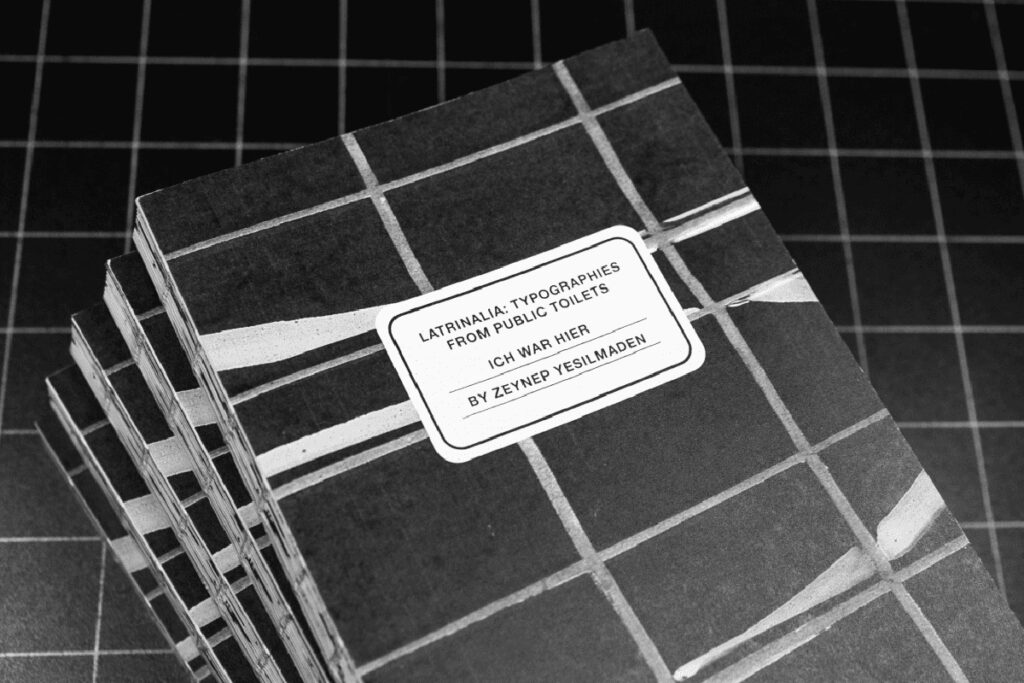
The master’s thesis ICH WAR HIER: Typographies from Public Toilets by Zeynep Yesilmaden is framed through the lens of typography and graphic design, questioning not only what art is, but how visual language operates beyond institutional control. While early art education often references canonical works such as the Mona Lisa to define artistic value, the focus here shifts toward vernacular and informal typographic practices—specifically, the handwritten marks found in public toilets.
Within the University of the Arts Bremen, latrinalia is examined as an unregulated typographic system. These writings, layered across walls, doors, and tiles, function as spontaneous acts of design. Letterforms vary in pressure, scale, rhythm, and style—ranging from quick, gestural scripts to bold, assertive markings. Without formal intention, individuals generate distinct typographic identities, where handwriting operates simultaneously as voice and visual signature.
These surfaces can be understood as evolving compositions. Similar to experimental graphic layouts, the walls accumulate layers over time, forming dense visual hierarchies. Text overlaps text, annotations respond to earlier messages, and new interventions disrupt existing structures. This continuous process transforms the toilet wall into a collaborative, ever-changing typographic field—an organic system shaped by multiple anonymous contributors.
Parallels emerge between latrinalia and established graphic design practices. The repetition of names and marks reflects mechanisms found in branding and logo design, where recognition is built through consistency and visibility. Tagging culture further reinforces this connection, emphasizing stylization and individuality as central to typographic identity. Unlike commercial design, however, these typographies are not produced to persuade or sell; they exist as direct assertions of presence.
The thesis extends into practice through processes of documentation and reinterpretation. Scanning techniques capture not only textual content but also material qualities such as line weight, texture, and surface irregularities. These elements are then reassembled into large-scale compositions using modular formats, echoing grid systems in graphic design while preserving the fragmented, layered logic of the original walls. Each fragment functions as a typographic unit within a broader visual system.
By relocating these compositions into public space, the work recontextualizes informal typography within a designed framework. What was once overlooked becomes a deliberate visual statement. This shift challenges established hierarchies within typography and design, raising questions about legitimacy, authorship, and visibility.
Ultimately, the thesis positions latrinalia as a form of collective, anonymous typography that exists beyond rules and institutions. It presents design not solely as a professional practice, but as an instinctive human behavior—one that emerges wherever individuals feel compelled to write, respond, and leave a mark.
More informations can be found here.