Read more
Deception starts in front of a screen, after a passing comment from a teacher or a colleague, with conflicting agendas. All of a sudden, it is all a bit too much. Design does not have its own identity—it is shaped by designers, academics, politicians, the tech industry, popular culture. Yet, since the moment students set foot inside a design school, it is sold almost as a mystical entity with a life of its own.
Students are drawn to, captivated by, and lured into graphic design for different reasons: a particular interest in the visual arts, a fascination with technology (old and new), visual form materialised quickly in the public domain, the creative and nomadic lifestyle projected by the media, especially online. They are exposed to two main options when entering a design programme: 1) professionalisation and 2) self-directed work. Both of these are usually complemented by contemporary concerns: sustainability, political conflicts, social justice, to name a few.
Design education is reduced to box ticking inside of a complex machine of colliding interests—local, national and continental cultures, the hosting institutions, the academic gatekeepers, creative and tech industries, and finally, the students and their families. Design schools are progressively transformed into a highly filtered battleground of promise, illusion and disappointment, in which different worlds are constantly in sight, but moving slowly enough for everything to remain the same.
Artificial Worlds
Lucy is captivated by Artificial Intelligence (AI). In high school, TikTok videos introduce her to text and voice-generated images, scenarios, films, and narratives. After logging in with one of her three accounts affiliated with Alphabet, she simply speaks out loud: twelve out of the twenty paired hearing-enabling devices at home process her request. She loves to be creative while daydreaming on the couch, waiting one second for images and videos to be projected onto the wall—or ceiling, if she is lying down. Images, renders, animations, and videos appear as she speaks. For her, it is entertainment as work.
Fortunately, her parents pay for the all-in-one subscription that gives her access to a basic package of creative apps and services—this is already covered by university charges. With the growing demise of traditional design degrees during the 2020 pandemic, AI services also begin selling subscriptions that bundle university programs with varying levels of time commitment and duration. Higher education has little alternative after the widespread staff cuts of the late 2020s: either strike lucrative deals with online businesses or face extremely aggressive competition from them.
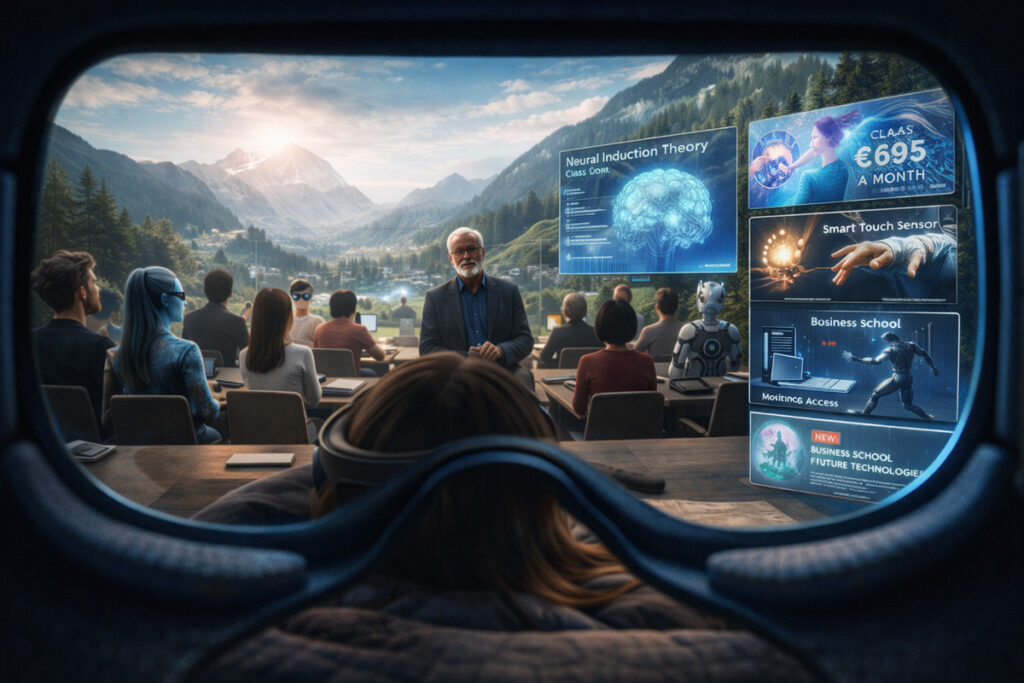
Lucy’s daily routine is predictably satisfying. She gets up, has breakfast, and either sits in front of a large screen or uses an augmented-reality headset, 3D cameras and sound on. Everything is customisable. EVERYTHING. The subscription plan has virtually an unlimited combination of options available. She can start at whatever time of the day she wants, and can see her colleagues or no one at all—even choose them one by one—, she can decide the physical appearance of her teachers or even have her own avatar teaching her—the option she prefers. While some sessions mimic a traditional classroom or auditorium, sometimes in wooden buildings or idyllic outdoors, others are fully adjusted to the client’s needs, personality and cognitive behaviour or disability. If only her parents could afford an extra €695 per month, she could upgrade to a better plan that would allow her to access touch and motion sensors and a series of neural induction theory packages she sees in ads during several classes. Personal contact rapidly eroded, as she entered kindergarten when the Covid-19 pandemic unfolded. It is unnecessarily long and complicated, even troubling at times. The absence of options and customisation in personal relations profoundly annoys Lucy; it seems outdated. All that is new feels instantly old.
Possible Worlds
After graduating from his 10-month degree, Eduardo provides design consultancy to AI services in the form of loose ideas, conversations, tagging, prompting, keywords, and images he either describes or drags, moving his hand in the air from his phone in the direction of KreatAI—a small and portable machine-learning device that monitors all aspects of his life. It is a vicious loop: AI systems inform his work and he feeds (and is paid by) them in return. KreatAI rewards human designers according to the amount, consistency, and variety of data they provide. Productivity control is also automated, as he constantly fears losing this gig. There is no difference between work and personal life, as all data is important for the design process. Privacy stops being a concern. Born in 2012, he belongs to a generation that hardly questions privacy, as it is simply normal to be monitored 24/7 in the name of innovation: from the cradle to his room, the school, and any street he walks. He presents himself as an AI Design Consultant, a disguised name for an exploitative freelance status in the wide spectrum of annotators—an activity popularised since the early 2020s, and now in demise.
Generative AI (GenAI) flooded graphic design’s daily routines. Burnouts surged. In 2026, the first lawsuit against Adobe draws attention to overproduction. Since Adobe Firefly became an integral part of designers’ tools, companies noticed that productivity increased and therefore demanded far heavier workloads. This led to relentless fatigue, as most designers realised that with the assistance of GenAI, they are expected to work longer hours, under greater stress, always struggling to keep up. What has been announced as a technological evolution meant to assist designers in their work, not replace them, turned out to be a silent, health-destroying, and unavoidable partner.
Eduardo is only 26 years old, but his eyesight starts to become a concern. Almost three decades ago, his mother breastfed him for four months, always while watching films, series, and reading emails on her recently launched iPad Mini. This is perhaps his first encounter with flashing lights and notification sounds while barely opening his eyes. After that, he cannot really remember not being surrounded by digital devices—from didactic games on apps for tablets, to his Alexa-enabled TV, or an old iPhone his mother gave him at 6 years old so he could be in touch with his parents, but only with 10GB of mobile data per month.
It is no surprise, then, that he easily takes on KreatOrb as a second source of income. Following the success of the iris-reading machine Orb by Worldcoin in 2022, many AI services pay people to roam cities seeking consented data extraction on a regular basis. Normalising tech slavery is an obvious agenda of these services, portrayed as open-source and participatory. The term E4E (Eye for an Eye) is used internally to label people collecting this vital asset for companies to work. Worldcoin notices that people are far more likely to share and sell their data if approached by another person. Docking stations in shopping malls or deprived areas of his city, Valencia, are either ignored or vandalised.
Printed books were a rarity during his childhood, as he grew up swiping through reels on YouTube and Instagram. Across Spain, publishers launched an aggressive and lucrative campaign to push digital manuals and ebooks for elementary school students, and Eduardo was part of this transition. He mainly learned to write using a screen keyboard, and it was convenient to have all his books linked to a single account, accessible from anywhere, without the burden of carrying extra weight to school. He enjoyed earning stars and badges for his homework, while his teachers appreciated the automated correction service the school subscribes to, which allows exams to be graded by the app and provides eagerly anticipated analytics. By the time he finished high school, he had already logged ten times the screen time his parents had at the same age.
Radical Worlds
At times, friends look at her suspiciously, but Ana is simply living in an environment she deeply enjoys. She goes to a NTS (No Tech School), which grows in popularity in the mid-2020s. Parents pay hefty fees for schools not to have Wi-Fi installed and architecture that blocks signals from nearby networks and antennae. Gardens are a luxury, as the most notorious NTS are outside city centres, functioning as digital detox camps. Primarily catering to middle-class families aiming to reduce the screen-time of their children, the school is a safe haven that makes sure a healthier balance is achieved without compromising the quality of education.
NTS’ premise is simple. Until the pandemic, the tech industry completely controls public discourse, education and strongly lobbies governments. But since then, a significant part of the population realises, after a colossal quantity of scientific studies, that a good part of the future is resting in the past. For these schools, the main goal is to tackle the gargantuan task of challenging the status quo while not depriving generations of a future. But ‘no tech’ is also big business, ignoring that in other regions of the globe such an approach is used successfully at very low cost. Biologic products and suspicious organic certifications are at war to break into the supply chain for these schools. While some NTS form cooperatives and rely on community support, others thrive on patronage, sponsorship and are accessible only to elites.
Local libraries collaborate in reintroducing used books banks where students can reuse the study books each year, seriously questioning the annual licences and non-transmissibility rules applied to digital manuals. Primary, elementary and high schools under NTS do not buy into the neoliberal agendas pushed by governments, even though they allow minimal tech introduction in high school. Emphasis is put on world-building, with a constant connection with nature, local communities in cities and villages.
Ana can do her homework with her manual and exercise book opened side by side, while her friends from other schools must close one to open the other on their 12’’ tablets. Ana is mocked frequently for “living in the past,” but the interlinking of disciplines in connection with nature equips her with a respect for history and systems that will be fruitful for her future.
After turning 18, she does not want to enrol in a classic university programme. Her interest in Arts cultivated by her parents makes her curious about design through a taste for objects, interiors, architecture and visual language. But, for someone with her background, design degrees are stuck in the past. The list of BAs focusing on technology far outweighs the rest: Creative Robotics, Virtual Reality, Immersive Media. Graphic Design continues to be almost solely dedicated to expanded branding, interactive advertising and augmented reality. The rest hide themselves in printmaking workshops, toying with old machines and making zines. The future starts and ends on a digital device, generating an asphyxiating dependency on Big Tech to devise and facilitate daily life through data extraction and monitoring. Despite a constantly promoted connectedness, individuality continues to be the most profitable segment to be exploited. Almost no one uses what is available in the public domain. Wasting resources instead of sharing them profoundly annoys Ana.
Other Worlds
Quitting was never an option. When he enters the surreal state of design education in 2029, Juliano is excited about a world of possibilities and opportunities. All Google Bard results about his professional inclination point to design. However, they are still being informed by humans—annotators tasked with pattern and data analysis, not critical insight into the history and evolution of the discipline.
Incited by his mother, Juliano did some annotation work at 15 to earn crypto for the summer. Like most of his circle of friends, he also thought the future was digital. After finishing his two-year programme in a blended environment of digital practices and book-making, Juliano felt deflated.
Famous designers trend for 3 or 4 years, then fade. Some friends split their time between studying and being content creators, copying each other in a race to guarantee recognition and income via ad revenue. Unless work is done manually in front of a tutor, it is nearly impossible to discover if it is produced by a student or an AI service—most are accessible by simply surrendering personal data. Design education is rapidly reduced to prompt literacy. Some of his friends enrol in 2025 in the first BA fully funded by OpenAI, a programme in which students permit full-time facial and voice recognition, language prediction, and object detection. The lack of facilities and rooms at his university is common, as programmes explore hybrid options with online supremacy, reducing undergraduate degrees to two years. His friends are transformed into training datasets.
Juliano looked into other programmes when, in the first week, he hears that more than 90% of students will not find work in design, but the financial burden of changing makes him think otherwise and he just continues to pull through until it is finished. Across Europe, Asia and North America, student exchange is mainly done online. Big consortia of universities reveal a cemetery of a zombie-discipline: outdated courses taught by academics at the end of their careers, swallowed by bureaucracy, mixed with some buzzworded ones. Some interesting courses are there too, opening up the spectrum of the discipline… looking outwards, not inwards. However, they are the exception, attempting to keep the discipline relevant and education products attractive to young students and parents alike.
Even when PAIntagram was introduced at university for students to apply to be design annotators, Juliano was not interested. It was the constantly-hacked AI branch of Pentagram after Michael Bierut sold his black book collection—along with other partners—to Anysphere, which feeds solely on the studio’s physical archive and “carefully curated” annotation by the partners’ teams after the 2024 debacle with the performance.gov project led by Paula Scher. Poor countries are exploited by tech companies, in the form of subsidised analysis groups to feed the kind of apps and systems he uses during his degree. The centralisation of universities seems outdated, with little use of public infrastructures or shared agendas. Each week another app or online service is fed to him directly to his mobile or wearable device. The amount of server farms using enormous quantities of electricity and water keeps growing, and lithium extraction continues to increase exponentially, as the climate crisis simply becomes normality, an unavoidable march to extinction. All of this makes him realise that maybe the future is not so digital after all.
Surreal Worlds
In 2027, what is known as the ‘Walsh/Wallis Case’ surprises the design community and expands ongoing efforts to regulate and legislate the use of AI. An experiment started in 2023 by a Boston-based startup, Autonomē, aims to boost the autonomy of machine-learning by attributing a monthly stipend disclosed as $5,000 USD for systems to use in order to enhance their productivity. If at first purchases include plugins, add-ons and extensions, as well as hours of human coders, the decision adopted by one of the engines focusing on declining professions arrives as a shock.
Project ATN279 seeks to develop market-leading creative services of autonomous prompting. The chosen route is the most popular model for the past century: the star designer. The virtual female designer Jessie Wallis is the sole creation of AI. Designed as an alias of American designer Jessica Walsh, Wallis is smartly styled as a Sia-lookalike designer, with 3-colour striped hair covering her eyes on her fake—but very active—social media accounts. She even publishes a manifesto titled The Future of Creativity, just like Walsh. Wallis runs an “award-winning creative studio,” with a series of awards also generated and monetised by AI, guaranteeing far more exposure than decadent initiatives such as D&AD, as well as securing revenue from gullible human designers. It is only when the studio wins the Swiss Design Awards that this increasingly popular studio surprises everyone. Hiring an actress and preparing the acceptance speech is a highly praised decision-making breakthrough for a machine-learning project to do autonomously.
Retrospectively, this choice was unsurprising. Jessica Walsh already published on Instagram in 2025 a post to “hire a creative who excels in AI prompting”. This underlines a collision, but also an overlap, between 4 groups of designers with competing ontologies of design itself: 1) AI-deniers: these designers believe that technology is coming for their jobs (and their lives), and invest in manual tools, relying on one-on-one physical meetings with clients and field research, often turning resistance into luxury commodities. Their nostalgia is tinged with anxiety. Mainly born in the 1970s or 1980s, they often commission young designers who can use AI tools to make substantial parts of their work that they cannot execute. In 2020, a small group forms a guild of anti-AI designers; 2) AI-converts: forced by the need to fit into the zeitgeist, these designers invest time in AI tools, knowing that they can increase studio productivity while demonstrating they are at the forefront of the design discipline. Although initially reluctant, ChatGPT, Midjourney and Mistral become mandatory companions for every design task: from writing to moodboards and pitch decks, renders or mockups to complete editorial projects with detailed prompting. Many present themselves as Prompt Curators, and boast they can finish “100 projects before breakfast” in their bio—they see themselves as translators between client desire and algorithmic possibility; 3) AI-critics: this group of designers is divided into two. Radicals refuse AI entirely, opting for low-power alternatives or no digital tech at all, often campaigning against planetary extinction by “digital suicide”. Researchers, meanwhile, seek to reveal who builds AI, where the data comes from, and who it serves. This last group often organises think-tanks, coding reunions and symposia to challenge, question and regularly dismantle dominant projects that promote inequality, ecological crimes and social injustice—while many contribute to organised groups that feed AI corrupted inputs as AI saboteurs, revealing the hidden violence of data extraction; 4) AI-fanatics: the final group are AI cheerleaders. Early adopters since the late 2010s, they proudly call themselves “AI-natives,” enthusiastically generating millions of images, clips, podcasts, and videos to showcase AI’s revolutionary potential while often hiding their own lack of skills or knowledge. They are the first to enroll their kids in AI-driven schools such as Alpha School—the “AI Powered Private School”. Since then, the extraordinary environmental burden of using AI for virtually every task in their daily lives becomes irrelevant to them. They live-stream their entire lives through GenAI filters, feeding their own memories into proprietary models. Thinking without algorithmic guidance is impossible.
By 2027, emulating a relatively famous designer through deep learning is extremely easy: extensive portfolios are available online, along with articles, news, and interviews in print, audio, and video formats, as well as work-in-progress posts and loose ideas scattered across multiple social media accounts. Books, too, are scanned for data analysis, identified as crucial training material for AI engines—objects into which designers have poured substantial time and attention in the name of quality knowledge-sharing, often inaccessible online. For this reason, many printed books are directly sponsored by AI startups and large corporations, with Meta and Oracle leading the way. However, in 2025, the startup Anthropic pays $1.5 billion to authors, in what is the biggest copyright settlement in US history, drawing attention to the common practice of downloading pirated books to train chatbots.
The Walsh/Wallis Case is famously dismissed after the Federal Office of Culture in Bern (Switzerland) sues Palantir for the damage caused to the Swiss Design Awards through Project ATN279. In an age of AI-generated influencers, scientists, hackers, politicians, and even doctors, designers, too, are consumed by competitiveness. While the studio &Walsh gains significant media exposure during the trial, its reputation ultimately dwindles, unable to demonstrate superiority over Jessie Wallis in terms of speed, versatility, productivity, and originality. In a TV interview, Walsh declares that design is doomed “if the industry transitions from form follows function, abandons form follows fun, and lands in form follows finance.” By that year, the fake industry already amounts to $18.4 billion annually in the United States alone. It has become an infinite vortex: the autonomous generation of the fake of the fake of the fake of the fake…
Probable Worlds
Just before the turn of the second decade of the century, Noorii takes advantage of the demand for virtually any human activity to be assisted. It is the perfect product to invade all households: the AI-powered robot Hollywood has fantasised about for a long time, with Elon Musk’s Grok 6. Produced by Tesla and connected by Starlink, with a wide segment of functionalities available per price range, it is almost unavoidable for designers. Noorii is a companion, sometimes a friend and confidant following the footsteps of Replika, an assistant, a teacher. Partnering initially with paid-per-minute tutors, Noorii steals a large chunk of students from universities, also able to demonstrate and execute the vast majority of physical tasks on cue. As other empires of AI-operated devices emerge in the ‘human-assistant’ segment, the physical and material consequences of their exponential growth for the planet continue to be catastrophic.
While discussions unfold about the bioethics of giving AI bots a humanoid shape, the sexbot industry is the one that benefits most from this investment.Sexbots enable photoshoots and livestreams that simulate human-operated services and designers, in an era when people yearn for human interaction. They are also hacked to perform other activities, as Noorii is frequently hijacked by the sex industry. Extreme customisation further pushes the idea of perfection. That is why the service PerDes borrows Lovescape’s “Create Your Perfect Boyfriend” to launch the highly popular “Create Your Perfect Designer.” In early 2028, the first physical design studio fully operated by aibots opens in Shenzhen, China’s Silicon Valley.
Produced by Unitree Robotics in collaboration with Final Spark, this studio comes under fire at the end of the year when it is revealed that the letterpress workshop producing “hand-printed graphic relics by Karel Martens” on the outskirts of Amsterdam is, in fact, operated by decommissioned sexbots running on bioprocessors from De Wallen, the red-light district. This business is sensationally shut down remotely overnight, while the repurposed sexbots are never found.
Cortical Labs combines lab-grown neurons with silicon chips and make it available to anyone in 2025. This becomes effectively tech’s biggest obsession due to its energy efficiency. Keeping neurons alive for more than 6 months is initially a challenge, but it is quickly tackled, as they seek to transition from responsive to reflective neural networks. Cortical Cloud is the first lab-grown “brain” rental service (wetware-as-a-service), available with the launch of CL-1, and neural cell cultures is the largest growing business of the decade. Experiments unfold rapidly in wealthy universities into startups and highly profitable subscription services. Renting CL-3s provides virtually unlimited and uninterrupted labour for any discipline, and design, as well as design education, are easily swallowed in the race for fully automated operation and monetisation.
AI transitions from super-trend in the early 2020s, to a cesspit of universal laziness, ultra-dependence, epidemic loneliness and a general feeling of self-absorption and loathing by the end of the decade. The total commodification of daily life is complete. AI always stands on three main pillars: labour exploitation, data colonialism and ecological degradation. A trench has opened between a massively profitable and complex machine of planetary dimension and a group of luddites with nothing but fear or good intentions. Hyper-personalisation killed design education. Its eagerness for scale resulted in self-destruction. Design ate itself.
We are now in 2029, and design cannot change: it needs to be completely reconfigured from the past, from history. Juliano quits design, equipped mostly with tools to be exploited and with little ability to think about alternatives to contribute to, or create, other communities of practice and forms of living. One design history tutor told him many years ago that design is future-making. From the rubble of his education, he now has to understand how to contribute meaningfully to the society he wants, not the one he lives in—and to scavenge for some answers in the knowledge acquired during his degree. Accidentally, he meets Ana today at a metro station, intrigued by a manuscript she holds in her hands titled School of Distributed Commons. Juliano introduces himself.
This essay was originally published in the book ‘Graphic Design (Education) After AI’ (2025), published by Stolen Books and is here available.
Author: Francisco Laranjo
Design and Research: Shared Institute
Year of Publication: 2025
Publisher: Stolen Books
Editor: Modes of Criticism