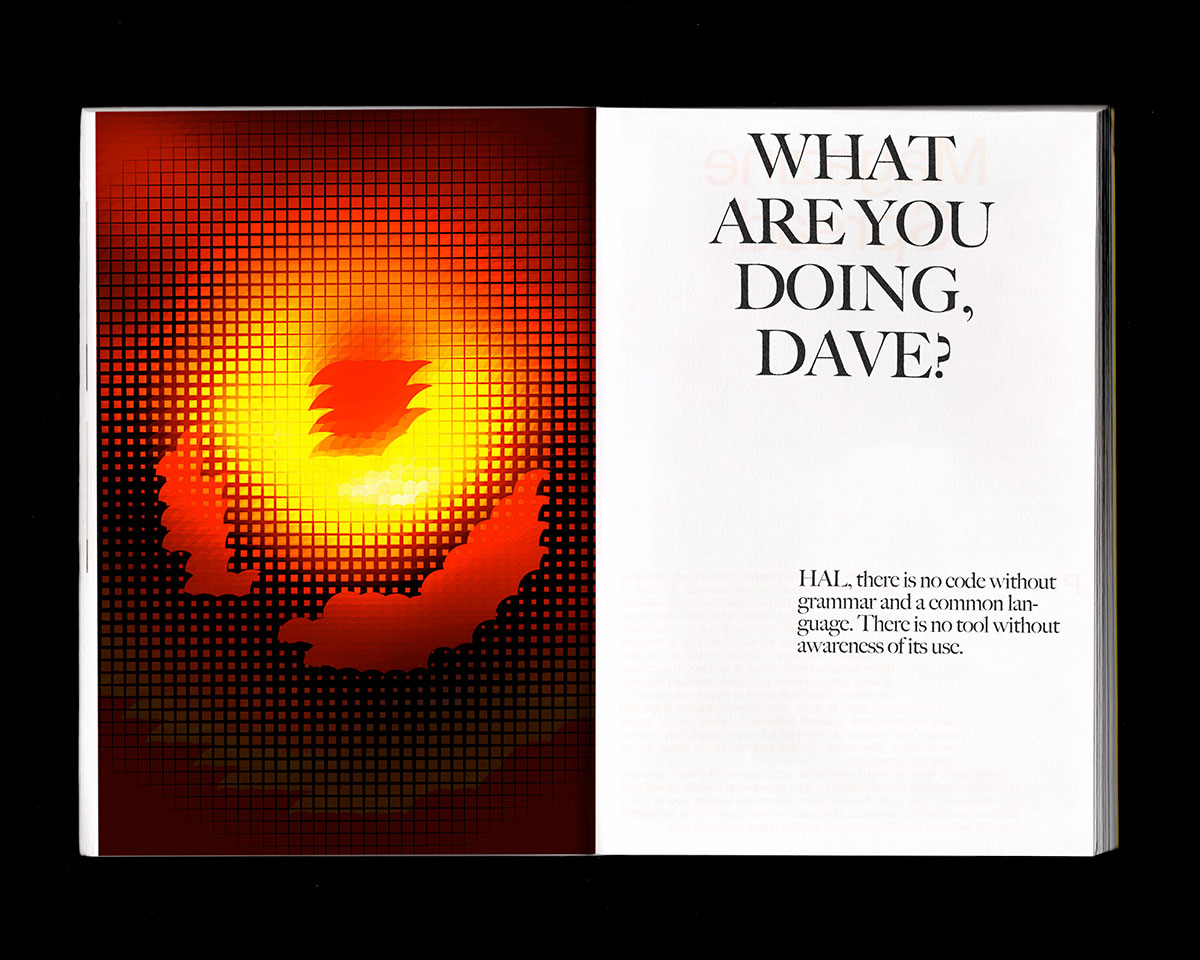
What Are You Doing, Dave?
A Critical Essay on Generative AI and Graphic Design
Tools Don't Replace, They Are Tools.
A passing glance at the history of design is enough to recall that Letraset did not replace the graphic designer. Neither did QuarkXPress. Neither did InDesign. The web leaves some room for doubt. Generative AI leaves considerably more. Every time, with every new wave of tools, the professional community has gone through the same sequence: panic, fascination, uncritical adoption. The relevant question has gone unanswered: not what the tool does, but what the project requires.
The graphic design community watches this evolution like someone standing in Plato's cave: it sees the shadows of tools and mistakes them for reality. When desktop publishing arrived in the eighties, the dominant concern was professional survival. When the web arrived, it was the turn of disciplinary identity crisis; when templates arrived, people spoke of democratisation—a euphemism for saying that anyone could produce visual artefacts without training. Now generative AI has arrived and the script repeats, with one difference: models evolve at a speed that makes the debate obsolete before it has even begun. We have it anyway.
What the Machine Draws From
To give a few examples: when Milton Glaser drew, he drew on Mantegna, on American comics, on psychedelia. Massimo Vignelli designed signage systems by drawing on decades of typographic culture, just as Stefan Sagmeister provokes by knowing exactly which tradition he is subverting. Experimental Jetset cites Dutch modernism with the awareness of someone who knows that tradition from the inside. None of them drew on a dataset, an encyclopaedia of design history, or an image bank: all of them had absorbed—Aristotle included. In the Nicomachean Ethics, Aristotle already distinguished ἐπιστήμη, demonstrable and universal knowledge, from τέχνη, the ability to make things according to learned rules. Epistème knows why something is necessarily true. Technè knows how to produce it. Design lives in technè but has spent decades seeking legitimacy in epistème—but I am digressing.
Generative AI does not automate design. It returns the statistical average of a vast visual corpus produced without critical hierarchy: an aggregate in which a Müller-Brockmann poster and an Instagram post carry equal weight, in which the history of the European poster and Canva's output coexist without hierarchy. The model cannot distinguish because it was not trained to distinguish—which makes it, in this respect, very similar to many of its users.
The point of contention precedes AI. For years, communication design has drawn visually on the world of technology while barely grazing its surface. The glitch effect reproduces digital error without knowing what produces a digital error. Kinetic typography animates text without asking whether movement serves reading. Circuit-board aesthetics appear on posters and packaging designed by people who have never opened an electronics manual. The compelling visual effect is copied; the structure is not understood. In some ways this is not even required—but returning to generative AI, we can say it is the updated version of a conversation the design community has been having for forty years. Design Thinking promised authentic innovation in five steps. The Double Diamond gave it new geometry. Agile sprints compressed the process into two iterable weeks.
The problem was never the original intentions, but what happened afterwards: codification, commercialisation, the transformation of situated intuitions into universal formulas. The recipe book.
Paul Watzlawick had already described this structure in 1967, in Pragmatics of Human Communication, when he wrote about the double bind. The double bind is a contradictory injunction that denies what it prescribes: "be spontaneous" is the paradigmatic example. Ordered spontaneity ceases to be spontaneity, just as prescribed creativity ceases to be creativity. Generative AI appears as the final chapter: creativity is no longer prescribed, it is generated. The paradox has become a machine. And most people—not just graphic designers, but digital designers too—think: finally, something efficient.
For years we have watched improbable competitions on the "dialogue between art and science" and found them almost laughable. The latest invitation is to "explore new forms of creativity" with AI—a formula on which Enzo Mari, who distrusted the word creativity profoundly, would have had something to say. The theoretical debate exists and is substantial: Moruzzi (2025) concludes that the question "can machines be creative?" is not the most pressing one—the social implications are. Almost no one is bringing this into the professional design community.
Art and Science: An Impossible Dialogue
In 1959, Charles Percy Snow delivered a lecture at Cambridge University that would become The Two Cultures: the fracture between humanistic and scientific culture as an unresolved epistemological question of Western modernity. He was not describing an opposition that could be overcome through interdisciplinary symposia. He was describing two ways of knowing the world that operate on different premises, with different methods and different criteria of truth. Sixty-six years later, the graphic design community organises conferences on the dialogue between art and science as though Snow had never written a word. The format is always the same: a designer and an engineer on a stage, a moderator asking where the two disciplines meet, applause, no answer. The atmosphere is excellent. So is the catering.
Communication design has lived for decades with a positional difficulty: too functional to be art, too intuitive to be science. This intermediate position generates a periodic need for external legitimation, and the most available surrogate is technology. It is easier to say "I used a generative model trained on a corpus of 400 million images" than to say "I studied Swiss graphic design of the 1950s and I know why it works." The first sounds like science. The second sounds like history—and history has no hype.
Those who have built a solid cultural genealogy do not feel that need. Erik Spiekermann knows where every typographic decision he makes comes from: he knows the tradition he is citing, he knows what he is doing and why. He does not need to legitimate himself. He uses technology—and knows it technically—without delegating his judgement to it.
No one claims technology is irrelevant; we obviously live in a hypertechnological era. Uncritical adoption reveals the absence of genealogy—what Isaac Newton called "standing on the shoulders of giants." The visual outputs of AI applied to scientific research—protein images, particle physics simulations, neural network maps—are incorporated as aesthetic objects without anyone asking what they represent. They are loans from an epistemological context that is not mastered, used to appear as something one is not, or simply because vintage is a mine of suggestions for an era that has not yet found its own codes.
Communication design has developed a form of futurology: positioning itself at the vanguard of technological transformations it lacks the tools to analyse. The enthusiasm for generative AI in design schools has this structure—an approach hungry for stimuli with an extremely short memory. The glitch effect replaces flat design, which replaced skeuomorphism, which replaced grunge, which replaced Swiss minimalism. None of these transitions produced historical understanding, only stylistic updating. Le Corbusier wrote that "style is the death of architecture." It may be the same for graphic design.
In 1981 Bruno Munari published Da cosa nasce cosa (How Things Are Born). The chapter on rice with spinach has become the most cited and most misunderstood reference in Italian design pedagogy. The provocation is not in the recipe: it is in the fact that even for something this obvious, analysis is necessary and not self-evident. Without analysis of the problem, any solution is arbitrary. The paradox is that this lesson has itself become a recipe. Munari would laugh—not pleasantly. He would probably laugh at this article too.
Analysis is the part of the work that education has stopped teaching—not because it is difficult to transmit, but because it is difficult to evaluate, above all difficult to transform into visible outputs. Rigorous analysis does not produce images. It produces questions, classifications, exclusions, hierarchies. It cannot go in a portfolio, though it should. In a training system oriented towards the production of visible artefacts, analysis is destined to lose.
The Unimark case illustrates what it means to analyse before resolving. In 1966, Bob Noorda—who had already tackled a similar challenge for the Milan Metr—conducted a meticulous analysis of passenger flow in New York's subway stations to determine decision points and the nature of the information required. Information was classified into three categories: identification, direction, information. Every element of the system was designed according to this hierarchy. Helvetica was not chosen because it was modern. It was chosen because it was legible under the specific lighting conditions of underground stations. Six years later, Massimo Vignelli applied the same logic to representing the entire network: the map he produced with Joan Charysyn was not a geographical chart—it was a logical diagram built on a 45 and 90 degree grid. It was contested in 1979 and rehabilitated in 2025. The context had changed: the smartphone had solved the geographical problem. The project, built on precise analysis, had survived.
Where the Machine Invents
A corporate identity system requires formal coherence across variable contexts, typographic hierarchies that hold up under reduction, color systems that work in both print and screen, grid logics that adapt without losing coherence. These are not aesthetic preferences. They are precise technical constraints.
A generative model produces outputs that are statistically plausible relative to the corpus on which it was trained. Plausibility is not correctness. A generated logotype may look functional on screen at 72 dpi and prove unusable in two-colour screen printing. The model can recognise visual patterns; it cannot resolve production constraints. Those who have practised analysis can recognise where the model is inventing rather than resolving, where the plausible output conceals an unresolved requirement. Those who have not accept the output as a solution. AI models are evolving, and some of these limitations will be overcome—but one thing remains: a more powerful tool in the hands of someone who cannot analyse produces more convincing errors, not better solutions.
Education
In 2003 Jeffrey Zeldman published Designing with Web Standards, arguing that the web has a semantic structure, that light colours behave differently from pigment colours, that accessibility is not an option but a philosophy. He simply defined the constraints of the medium with a rigour no traditional graphic design manual could offer. Today many graphic designers sketch smartphone interfaces on paper while ignoring those constraints—and more than twenty years have passed. Why? The foundational literature exists but is neither read nor assigned. It is available on Amazon for twelve euros.
Andrea Pazienza is an example that emerges from my mentoring practice, and I could name others. I cannot exhaust the subject of design education here, nor would it be honest to try: the reality I observe shows widespread gaps—in art history, typography, communication theory, knowledge of media. Pazienza is one of the greatest authors of twentieth-century European comics. His line is of absolute quality: an artist who fused art, politics, and fierce irony. In Italy he is a foundational figure of the generation of '77. Outside Italy he is less known than he deserves, particularly in the anglophone world, though in European auteur comics his name circulates among those who know the history of the medium. Among Italian design students, no one knows he existed. This is the signal of something deeper: a form of education that fails to transmit the historical awareness needed to distinguish influence from dependency, citation from unconscious borrowing.
Vignelli's famous axiom—"if you can design one thing you can design everything"—presupposed a deep mastery from which to expand outward. That is something else entirely. What education produces today is a multitasking workforce for a labour market that demands flexibility over competence and speed over depth, where deeper study is delegated to personal initiative—which is a polite way of saying it does not happen.
Responsive design illustrates what happens when a technical solution dispenses with design thinking: it produces interfaces that display on any screen but are never truly suited to any of them. A smartphone is not a shrunken desktop—it has a different context of use, different interaction modality, different attention span. Designing for mobile means rethinking the information hierarchy, not resizing it. The technology to do better exists, but it requires what education no longer teaches. Those who arrive at generative AI without having built a solid foundation accept it as a given. The market demands this. Education prepares them for it. The cycle closes.
The Designer as Data
There is a distinction the professional debate tends not to name. Photoshop costs money because it sells—or rather, now rents—a tool. Free generative tools do not sell a tool: they collect data. Every prompt is a sample of aesthetic judgement. Every refinement choice is a datapoint of formal preference. When the product is free, the product is you.
The designer who uses a generative tool for free is surrendering, session by session, their own judgement as training material. Individual creativity, accumulated through years of practice and culture, is transformed into statistical pattern, aggregated with that of millions of other users, and returned as average output. The designer is no longer a subject who uses a tool. They have become a statistical sample feeding a system.
This is one of the social implications that Moruzzi (2025) identifies as most urgent—far more urgent than the question of whether machines can be creative. Almost no one in the professional design community is discussing it with the seriousness it deserves: the conversation is about style, workflow, prompt engineering, which version of the model produces the most convincing fonts. What is being surrendered, to whom, and for what purpos—that conversation is not happening.
We are not debating whether to use AI: it is being used, and it will be used. It is not even necessary to understand how it works technically—that is a specialist question. What matters is allowing oneself the minimum of doubt: what does it produce, what does it consume, what is being given away and to whom. Umberto Eco, cited by Maurizio Calvesi in Avanguardia di massa (1978), observed that the language of the avant-gardes, born in their laboratories, came to be practised to perfection by groups who had read neither Céline nor Apollinaire—having arrived at that language through music, the dazibao, the party. And the high culture that understood that language when it was spoken in the laboratory no longer recognises it when it finds it spoken by the mass. Communication design is in exactly this position: it has adopted the language of technology without understanding its structure, and can no longer recognise it.
I close with a question: is doubt the only tool the machine cannot return as output? We shall see.
Written by Claudia Costantini.