Read more
PARAMETRIC FONTS
I’m going to talk about a future. Not the future: I’ve abandoned any pretension of prediction; AI
makes the landscape too unstable for that. It’s simply a plausible scenario. One in which AI
doesn’t replace the type designer, but amplifies their operational capacity through supercharged
workflows.
In that future, the structural constraints that today limit huge multilingual or multiaxis
“superprojects” disappear. Families can be produced across multiple writing systems, including
those traditionally foreign to many Western designers, like Arabic or CJK, without requiring an
unmanageable multiplication of resources. And a superfamily no longer expands only in weight,
width, or angle: it expands across any structural dimension of the letter.
A precedent: Metafont
The foundations of this scenario aren’t in the future, but, as almost always, in the past.
Specifically, in the work of Donald Knuth and his Metafont system. Developed in the late 1970s
and early 1980s, Metafont didn’t describe letters as static outlines, but as mathematical
constructions defined by parameters. Every variable (stroke thickness, tension, serifs, spacing)
could be independently adjusted within a formal system. From this set of rules, the system would
automatically generate a type family. In practice, its influence was more conceptual than
productive: its technical nature made it inaccessible to most designers, and its model lacked a
real-time graphical interface, so designers struggled to achieve a final visual quality that could
compete with the simpler model of drawn outlines that PostScript would later dominate in
publishing production.
Supported by the infrastructure of variable fonts, contemporary design and programming tools,
the promise of parametric typefaces becomes technically viable once again.
Base and blended Axes
In this context, Font Bureau, with David Berlow at its center, has spent years developing a
specification to formalize this new paradigm. Their work extends far beyond adding new design
axes, exploring new ways to define and control interpolation. Unfortunately for them, they don’t
have that AI assistant yet.
The specification distinguishes two categories of axes: base axes and blended axes. Base axes
operate on the fundamental structural dimensions of a character. They don’t represent perceived
styles (like “weight” or “condensed”), but the building blocks of the form itself. They’re named
according to which of the two-dimensional axes they mainly act upon—X for horizontal, Y for
vertical—and whether they affect the character’s opaque (black) or transparent (white) areas.
Thus, we can talk about variations in the structural thickness of a stem (X OPaQque, XOPQ), in
horizontal negative space (X TRAnsparent, XTRA), in vertical contrast (Y OPaQue, YOPQ), or the
primary aspect of x-height, understood as the vertical dimension of internal white (Y Transparent
LowerCase, YTLC) (https://variationsguide.typenetwork.com/).
Blended axes, on the other hand, don’t operate directly on a single elemental aspect; they result
from a weighted combination of multiple base axes, used in concert. The traditional “Weight” axis,
for example, isn’t a single variable: it simultaneously modifies stem thickness (X Opaque, XOPQ),
horizontal negative space (X Transparent, XTRA), vertical contrast (Y Opaque, YOPQ), spacing (X
Transparent SPacing, XTSP), lowercase height (Y Transparent LowerCase, YTLC), and even
additional parameters like overshoot.
The coexistence of base and blended axes produces type systems with high structural flexibility.
Adjustments can be made at a microscopic level (within the internal dimensions of a character)
without exponentially multiplying masters. Paradoxically, the more sophisticated the design space
architecture, the lighter the final file can be, provided masters and the design space are correctly
modeled.
However, for this paradigm to move beyond the experimental realm, technical support or
institutional backing isn’t enough. Tools, still in their infancy, must radically simplify the
management of these structures. In practical terms, we’re manipulating a high-dimensional vector
space without an adequate visual representation. We’re effectively trying to navigate a map with
dozens of dimensions while our intuition evolved to understand only three. Without an interface
translating this mathematical complexity into a perceptually understandable system, parametric
design remains limited to those who can think simultaneously as type designers and system
engineers. This is also precisely the kind of problem where AI may prove more valuable as a
cognitive interface than as a drawing tool. Some additional tools that need to evolve are the
following.
HOI (High Order Interpolation)
First described and implemented by the foundry Underware, HOI proposes that interpolation
between masters doesn’t have to follow a straight line (linear), but can follow a predefined curve
(non-linear), using a construction analogous to Bézier curves. Strictly speaking, HOI isn’t essential
to build parametric typefaces. However, in high-dimensional spaces, linear interpolation is
insufficient if optical coherence across the full range of variation is desired. HOI isn’t cosmetic: it’s
a structural stabilization mechanism. While plugins now exist that give designers basic HOI
control in applications like Glyphs, these tools remain rudimentary. (https://underware.nl/case-
studies/hoi/)
Blended axes
We need an intuitive way to compose and manage blended axes. Currently, this can only be done
through coding, combining and weighting multiple base axes to produce a coherent blended axis.
But this operation involves modeling structural dependencies between dimensions that are often
non-orthogonal. In practical terms, we’re manipulating a high-dimensional vector space without
an adequate visual representation. Without an interface translating this mathematical complexity
into a perceptually understandable system, parametric design remains limited to those who can
think simultaneously as type designers and system engineers.
Fencer
Alongside blended-axis management arises another structural need: the ability to remap regions
of the design space. Parametric base axes operate over dimensions that readers are not
accustomed to perceiving as independent variables. Consequently, pushing them to extremes can
produce configurations that are formally unstable or perceptually disruptive. These "typographic
monstrosities" are not necessarily undesirable (in display or experimental contexts they can
become valuable expressive resources) but for text typography they often need to be constrained.
Traditionally, this remapping has required manually editing variation data, making the process
difficult to visualise and even harder to control. As of June 2026, Lawrence Penney's Fencer
introduced a much more intuitive way of interacting with these transformations. Rather than
representing a fundamentally new technology, Fencer provides a visual environment for shaping
and understanding the behaviour of the design space. Its greatest contribution is therefore
conceptual and ergonomic: it allows designers to see and manipulate relationships that would
otherwise remain hidden inside the font's variation tables (https://github.com/Lorp/fencer)
If remapping changes the trajectories through the design space, the next step is to change the
structure of the space itself.
AVAR2
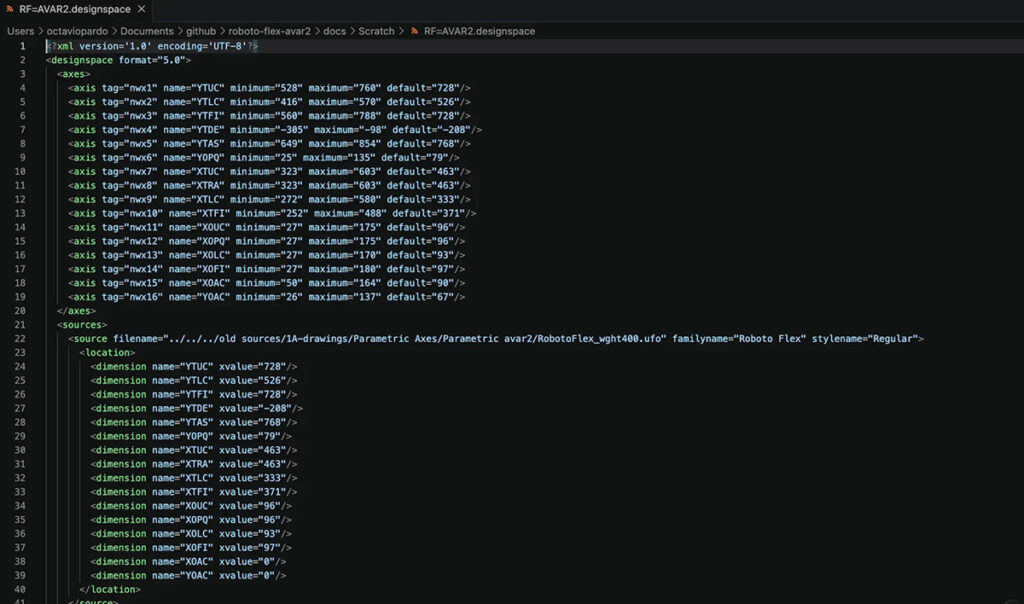
The next advancement isn’t a design tool but a structural extension of the font format itself: the
evolution of OpenType’s avar table. The AVAR table (Axis Variations) allows modification of how a
variable axis is interpreted internally without changing the values visible to the user. In a variable
font, axes are mathematically normalized before interpolating between masters. AVAR introduces
a non-linear mapping over that normalization, adjusting how interpolation progresses along the
axis. In simple terms: if a designer feels that a typeface’s optical “Regular” doesn’t exactly match
the axis’ nominal 400 weight, the avar table can remap the axis so that the internally correct value
appears as 400 to the user. This corrects perceptual imbalances without adding new masters or
increasing file size. Interpolation becomes optically coherent without increasing visible structural
complexity.
AVAR2 represents a qualitative leap. While AVAR operates on a single axis, introducing one-
dimensional distortion, AVAR2 allows multidimensional transformations across the entire
interpolation space. Rather than simply adjusting the internal curve of an isolated axis, it models
how multiple axes interact within the parametric space. Geometrically, it means abandoning strict
orthogonality between dimensions and accepting that the design space itself can be structurally
deformed. Instead of imagining axes as perfectly independent sliders, we begin to treat the
design space more like an elastic surface, where moving one dimension can subtly reshape the
behaviour of others.
In complex parametric systems, assuming all axes are independent inevitably leads to a
proliferation of corrective masters. Each unforeseen interaction demands additional nodes in the
design space, exponentially increasing complexity. AVAR2 allows many of these dependencies to
be modeled structurally, integrating them into the deformation of the space itself rather than
resolving them through accumulated exceptions. The potential result is a drastic reduction in
required masters and, therefore, in the final file size.
Today, tools such as Fencer provide an intuitive visual interface for defining these
multidimensional remappings. However, Fencer is ultimately an editor rather than a technology in
itself: the resulting behaviour is encoded directly in the AVAR2 table, meaning equivalent results
can be achieved without it through manual editing. Its real contribution lies in making these
complex spatial relationships easier to visualise and manipulate.
Even so, AVAR2 management remains fundamentally intuitive and experimental. Since
conceptually navigating spaces beyond three dimensions is cognitively unfeasible without
adequate representation tools, implementing it in complex parametric projects remains a colossal
challenge. Ironically, these multidimensional relationships are often easier for machines to model
than for humans to reason about directly.
Back to the present
What I’ve described it’s been in development for over ten years by David Berlow, who, a year from
retirement, still has a vision far beyond almost anyone else’s. They are currently working on
Roboto Flex (internal code: Roboto Delta), a monstrous system with four registered axes (optical
size, weight, width, and Grade) and 35 independent parametric axes. Each dimension can be
adjusted separately: cap height, ink traps, overshoot, word-spacing width, combining Greek and
Cyrillic alphabets in a file of over 1,000 glyphs contained in just 600 KB, and using only 68
masters instead of the 549,755,813,888 that would normally be required.
These projects are nearly unfeasible outside super-corporate structures that can absorb the cost
of dozens of masters and thousands of work hours. Their complexity far exceeds the needs of
any ordinary user, so until design tools allow operation at this scale with efficiency, widespread
adoption will remain limited.
But… in a future?